Posts

Showing posts with the label British Route

The British Experience - “Two Hundred Miles From Saratoga To Boston”

Image
When I last wrote about  what the Convention Army looked like , I indicated that I was not aware of any image depicting the 1777 march.  Since then I've come across one, in a 1778 British political cartoon in the Library of Congress entitled  "The Closet" .  It shows, among other things, King George III with several of his advisors, and two panels labeled "Saratogha" [sic].  One of the Saratoga panels, pictured here, shows a column of soldiers marching off into captivity, hands bound, as American troops look on from a distance. Their commander, Lieutenant-General John Burgoyne, leads his men sword in hand , and a copy of his play "Maid of the Oaks" under one arm and book of poems under the other, and remarks of his downcast followers:  "I have led my Rag-o-muffians where they have been Peppered" . While there is nothing that suggests this image was drawn from life, especially since Burgoyne rode to meet Gates at his headquarters before depart...

Western, Westurn or Weston? - "The Same Road To Boston"

Image
The Convention Army arrived in Western, Massachusetts, from two different directions.  American Brigadier-General John Glover had ordered the captives to march in two separate columns after the surrender at Saratoga ,  "... one Division of the prisoners, Consisting of 2,442 British troops, by Northampton, the other by way of Springfield, Consisting of 2,198 foreign troops..."  . [1 ]   Two weeks later, after the British column reached Brookfield , and the German column left Palmer , a German officer would note: "November 2  We marched through Weston, a rather nice village, 15 Engl. miles to Brookfield.  The Engl. corps crossed us today on our march and from now on had to march on the same road to Boston with us.  As this corps had arrived in Brookfield before us and consequently taken possession of the houses, it was evident that our corps had to bivouac." [2] Massachusetts militia private David How, who crossed the Connecticut River on October 29th ...

The British Continue On - “March Through … Ware”

Image
The British troops who surrendered at Saratoga were apparently well rested when they left Hadley, Massachusetts , on October 30, 1777.  Many would march through Amherst ,  Belchertown  and Ware before they stopped to spend the night in Western.  "[Oct.] 30 Thursday..."  wrote Massachusetts Militia Lieutenant Israel Bartlett,  "We marched thro’ Belcher[town, from Amherst] and Ware and put up at Weston [Western then, now Warren], about 20 miles from Amherst.”   Private David How didn't specify how far he marched, but noted: “[Oct.] 30  This morning we Set off [from Hadley] march Through Belcher[town] And Ware River. at Night We Staid at Westurn [Western, now Warren].”   British Lieutenant Francis (Lord) Napier of the 31st Regiment of Foot stopped a bit sooner, noting:  "October … 30th. [Marched from Hadley to ] Weir - 17 M[iles]"   [1] British accounts of the march from Saratoga to Cambridge tell us nothing about the town of War...

Two Weeks On The Road - “Marched Through Belcher”

Image
In September of 1774, as towns across Massachusetts reacted to laws passed by Parliament to punish the colony for its resistance to British rule, the residents of Belchertown, Massachusetts, approved a statement which read:  "We declare that we will take no unreasonable liberties or advantage from the suspension of the course of law,  but we agree to conduct ourselves agreeably to the laws of God, of reason, of humanity; and we hereby engage to use all prudent and justifiable and necessary measures to secure and defend each others persons and families, their lives, rights and properties, against all who shall attempt to hurt, injure, or invade them, and to secure and defend ourselves and our posterity our just and constitutional rights and privileges."  [1]    Seven months later, when fighting began at Lexington and Concord on  April 19, 1775 , the "necessary measures" they pledged to take would for the most part involve sending men and materials out of tow...

Beyond Hadley - "Place Called Amherst"

Image
There isn't a lot of information that ties the town of Amherst, Massachusetts, to the surrender at Saratoga  on October 17, 1777, or the march of the Convention Army.  Militiamen from Amherst were called up to serve during the Saratoga campaign, as was the case in towns across Massachusetts.  A history of the town written in 1896 states in its introduction "Along its highways marched the captive troops of Burgoyne on their weary journey from Saratoga to Boston."  Unfortunately their passing receives no further mention, but the authors do quote from a letter allegedly written by a descendant of the owner of a tavern in town to claim that:  "During the war of the Revolution, a detachment of Burgoyne's army officers, who had gone out to attend a dance near Saratoga, were captured and brought under a guard to the Clapp tavern, on their way to Boston."   The tale continues on to relate that as straw had been spread on the floor for them to sleep on, the lan...

The British At The Connecticut River - "Crossed The River At 10 O'Clock"

Image
On October 29, 1777, the British Column of the Convention Army faced the last remaining major natural obstacle on their march to Cambridge, Massachusetts.  The day after their surrender at Saratoga they had crossed the Hudson River .  In the tens days that followed they had marched through a corner of Vermont , south to Pittsfield, Massachusetts , and then east to  Northampton,  on the west bank of the Connecticut River. Rivers were a formidable obstacle to travelers in the eighteenth century, especially an army numbering in the thousands which included soldiers (and some of their wives and children) marching on foot, officers on horseback, and horse or ox-drawn wagons loaded with personal belongings, equipment and supplies.  There was no bridge from Northampton to Hadley, or anywhere else along the Connecticut River in 1777.  The first was not completed until 1785, fifty miles upstream, between Walpole, New Hampshire, and Bellows Falls, Vermont. [1] Crossi...

Worthington And Chesterfield Massachusetts - "Bad Mountains And Deep Mud"

Image
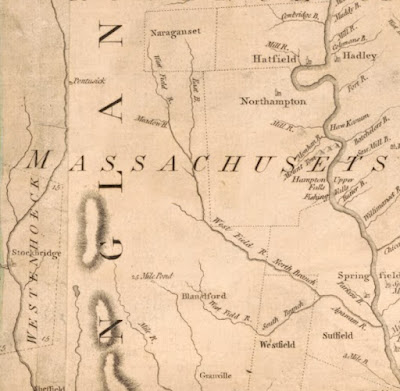
After leaving Pittsfield , much of the British column of the Convention Army marched through what was then  Partridgefield  to Worthington, Massachusetts, where they would stay on the night of October 25, 1777.  The following day some proceeded on to Chesterfield and stopped again to spend the night.  Their march to  Northampton  on October 27th would be the halfway point in their journey from the surrender at Saratoga , New York, to their confinement in the barracks at Winter Hill in Charlestown, Massachusetts, both in days and in distance.   Worthington, incorporated in 1764 , was one of what were three Berkshire hill towns then, but five towns now, that the British column would march through from Pittsfield to Northampton.  Chesterfield , to its east, had been incorporated in 1760.  Neither Worthington nor Chesterfield was marked on Captain John Montressor's 1775 map of New England, shown here in part as published in London in 1...

Lost Names - “East Mountain and Patreidge Field”

Image
On October 25, 1777, the British column of the Convention Army marched through a region with place names that have changed considerably since that day.   “This morning we Set out [from Pittsfield] march’d through the East mountain and patreidge field.”  noted Private David How, one of their guards with the Massachusetts militia. [1] It's unclear from what I've read as to exactly where East Mountain was (or is).  Partridgefield, which the British prisoners and their guards would all pass through after leaving Pittsfield , was one town in 1777, and just six years old.  Now it is three towns, Dalton (incorporated in 1784), Hinsdale (incorporated in 1804), and Peru, allegedly renamed as such in 1806 :  "because it is like the Peru of South America, a mountain town, and if no gold or silver mines are under her rocks, she favors hard money and begins with a P."   Regardless, their march on the 25th would not be easy.   When the British column reach...

Pittsfield, Massachusetts - "Frequently Called Upon To Fight"

Image
The  British troops captured at Saratoga and their guards began arriving in Pittsfield, Massachusetts, on October 24, 1777.  Lieutenant Israel Bartlett of the Massachusetts militia wrote in his diary for that day: “Marched 7 miles to Pittsfield [from Lanesborough] and halted at good quarters.” [1]  British Lieutenant Francis (Lord) Napier of the 31st Regiment of Foot noted that he marched six miles and arrived at Pittsfield that day as well, but nothing further, as had been the case with each entry since the surrender. [2]  Massachusetts militia private David How, and those who appear to have been traveling a day behind the first division caught up, as he noted: “[Oct.] 24 This morning we Set out [from New Ashford] march’d Through Lainsborough  Staid at Night at Pitsfield”. [3] It was a relatively short march, and apparently an uneventful stay.  Once again primary sources for the march of the British column offer limited information on their stopping in ...