Posts

Vermont - "A Numerous Banditti"

Image
On October 21 and 22, 1777, the now extended British column of the Convention Army left the state of New York.  In doing so, they briefly left the United States as well.  The anonymous journal of an officer of the British 47th Regiment of Foot records overnight stops in Saint Croix, New York, on the 20th and Williamstown, Massachusetts, on the 21st.  Lord Napier's journal lists the same stops on the same days, but not the route he and his colleagues followed to Williamstown.  Massachusetts Militia Private David How noted however, that after stopping five miles from Saint Croix on the night of the 21st:  "[October] 22 This morning Set off march'd Through Whosuck And pownal and at night We Over Took the Body of Regulars at Williams Town And Stopt there" . [1]  How had passed this way before, while traveling in the opposite direction to join the Northern Army.  On that trip he had passed through Williamstown, and then Pownal, Vermont, on October 9th,...
The British Route: "March'd 5 Miles To Saint Cork"

Image
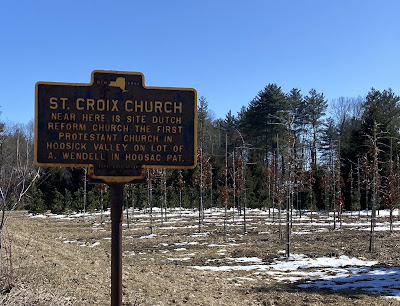
When the British column left Tulls Mills, New York, on October 20, 1777, they did so without their German comrades.  Once again they made little progress.  Massachusetts Militia Private David How noted "This Day march'd 5 miles to Saint Cork."   British Lieutenant (Lord) Francis Napier recorded  "Marched to a place near St. Coicks Mills" .  Both were challenged by the spelling of rural place names.  They stopped that night at Saint Croix, the site of its church now marked  with a signpost  outside North Hoosick, New York, on Route 67. [1] October 20th was not How's first time in Saint Croix.  He had marched through the area ten days earlier, on the way to reinforce Major-General Horatio Gates and the Northern Army.  His militia company's route north from Pownal, in the southwest corner of Vermont, to Bennington, then east into New York took them through towns How called  "old Whosuck And Saint Cook" on October 9th and 10th. [2] Aft...

Burgoyne's British Troops - "Habit And The Usage Of Fighting"

Image
April 19, 2023, is 248th anniversary of the first battle of the American Revolution, fought at Lexington, Concord and along the British retreat to Boston.   This is a good time to look at those regiments of the British Army which made up a substantial part of the Convention Army, including one that fought on what has become "Patriots Day" in Massachusetts.   An online summary of the fighting at Saratoga in 1777 states that defeat of "the superior British army" was crucial to the United States winning the Revolutionary War.   What would have made the British army superior in the Saratoga campaign?  Although Lieutenant-General John Burgoyne's forces outnumbered the garrison posted at Fort Ticonderoga and Mount Independence in July of 1777, numerical superiority was lost as the campaign progressed.  At the time of the surrender, Burgoyne claimed he faced 16,000 Americans with an effective force of only 3,500 troops. [1]   Burgoyne's troops...

The March Begins: "We Had To Bivouac In Meadows Assigned To Us"

Image
The area east of the Hudson River, across from Stillwater, New York, bustled with activity on October 19, 1777.  Over 4,000 British and German soldiers, some with their wives and children, had crossed the river starting the day before.  Their campaign to end the rebellion of Great Britain's American colonies was over.  What would be years in captivity for most had just begun.  Major-General Horatio Gates summarized the situation, writing: "...  they are now upon their march towards Boston; General Glover, and General Whipple, with a proper Guard of Militia, escort them; and are to provide all such necessary Articles, as may be wanted upon the march….” [1]   Private David How  was one of those militia guards.  His diary shows little progress for the first few days of the march.  The British having crossed on the 18th, he wrote,  "This Day [the 19th] we have been fixing For a march and at noon we Set out with the prisoners for to Guard th...

Stillwater, New York - "We Crossed The Hudson In A Few Boats"

Image
A handful of markers commemorate the 1777 march of the Convention Army.  One is in Stillwater, New York, on the corner of Route 4 and Ferry Lane, a short distance from the west bank of the Hudson River.  Its location puts it at what might be considered the start of the march.  Some question if the crossing occurred there.  Regardless of the answer, it only notes the crossing of "Brunswick Troops", not British troops who began crossing the river on October 18th.  In an odd contrast, the  Stillwater town history website  notes only the crossing of British troops.   One of the Convention Army who crossed in 1777 noted that Stillwater was aptly named, as:  "In this region, the Hudson is unusually sluggish for 3 Engl.[ish] miles and you hardly notice the motion the very slight motion of the water." [1]  Today, an iron frame bridge spans the river about one-thousand feet below the ferry site, just north of where the Hudson is joined...

Worcester, Massachusetts - "A Small Neat Town"

Image
By 1777 the central Massachusetts town of  Worcester, forty miles west of Boston, had a reputation as friendly to the patriot cause.  Residents had  shut down the courts  in September 1774, in what author Ray Raphael argues was the true start of the American Revolution.  Patriot printer Isaiah Thomas, who fled British controlled Boston in April of 1775 due to the political views expressed in his newspaper the  Massachusetts Spy , subtitled  "Or, American ORACLE Of Liberty" , published an account of the fighting on April 19th at Lexington and Concord in his  first Worcester issue  on May 3rd, 1775.  Worcester residents had served as militiamen and Continental soldiers in the Northern Army that had stopped British Lieutenant-General John Burgoyne and his army - and allegedly one of his messengers.  Like many Massachusetts towns though, it was also home, or   once home, to Loyalists  a s well.   On October 22, 1777,...

Post Roads and Milestones - "53 Miles From Boston"

Image
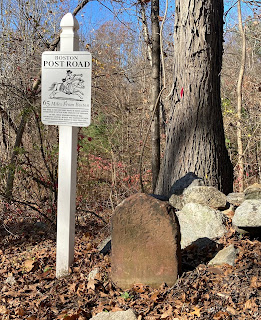
A goal of this blog is to find, see and share some of what the Convention Army saw on their 1777 march from Saratoga to Cambridge.  Milestones, markers set at one mile intervals along part of their route, are one such example, and a clue to which roads they took - especially where original sections of those roads have been replaced.  They also revealed to me that for years I had overlooked links to the past just miles from my home. The story of post road milestones in New England is traditionally linked to Benjamin Franklin, in his role as Deputy Postmaster General.  According to many accounts, in 1767 he personally placed red sandstone markers at one mile intervals along what is known as the Upper Post Road from Boston through Springfield, to New York City.  Typical is this one pictured, located in Brookfield, Massachusetts, 65 miles west of Boston. The problem with this legend is that in what I've read to date, no primary source is cited to link Franklin or the 176...

What The Convention Army Looked Like - "The Most Agreeable Sight That My Eyes Beheld"

Image
The surrender at Saratoga was bound to attract attention.  Countless paintings and engravings picture defeated British Lieutenant-General John Burgoyne offering his sword to American Major-General Horatio Gates.  I've yet to find a contemporary drawing, painting or print depicting scenes from the three week march of the Convention Army.  The closest I've come is this print in the Library of Congress , which shows curious onlookers, including what appears to be a person of color, watching as American guards escort Germans captured at Trenton to Philadelphia in 1776.  Fortunately, a number of memoirs, diaries and letters describe the Convention Army as it passed, from the beginning of its march at Saratoga to its arrival outside of Boston.   Among the many American witnesses present at the start was Colonel Jeduthan Baldwin, who recorded in his diary that on October 17th, "About 11 o clock the enemy laid down there arms & Marched out thro our Army th...