Posts

Showing posts with the label Cambridge MA

The German Experience - "We Finally Reached Boston"

Image
British accounts of the 1777 march of the Convention Army after the  surrender at Saratoga  are brief, with the exception the letters published by Ensign Thomas Anburey in 1789 under the title "Travels Through The Interior Parts Of America" .  German accounts of the march are rich in detail, and describe not only where they went and when, but what they saw and did along the way.  In addition, a series of drawing available online through  The New York Public Library Digital Collection  by Hessian Captain Friedrich von Germann show us what various German regiments looked like before the Saratoga campaign started, such as this soldier from the Brunswick Regiment von Specht.   German accounts of the 1777 march range from the memoirs and letters of its commander, to the brief diary entries of one of his soldiers, and include one kept by a woman, the wife of Major-General Friedrich Adolph Riedesel , the commander of General Burgoyne's German troops....

The Convention Army Arrives - "The Barracks At Cambridge Near Boston"

Image
I intended this blog post to focus on Cambridge as the final stop of the march of the Convention Army.  Two things changed that.  The first was learning that while Burgoyne and his senior officers were primarily quartered in Cambridge, his troops were held in Continental Army barracks on Prospect Hill, the site today marked by the magnificent stone tower shown below, and Winter Hill.  The second was visiting Somerville, which in 1777 was still part of Charlestown and is where both hills are located. The 1777 march of the Convention Army began in earnest on October 18th, with many thinking their destination was Boston.  German Grenadier Johann Bense noted in his diary for that day  "... we set out for Boston..." [1]  A letter dated October 22nd from Greenbush, New York, published in the Massachusetts Spy in Worcester, noted that after grounding their arms, Burgoyne's troops "... marched down to Stillwater, and crossed Hudson's river the 18th in order to ma...

General Burgoyne Continued - "Attended Mr. Burgoyne To Boston"

Image
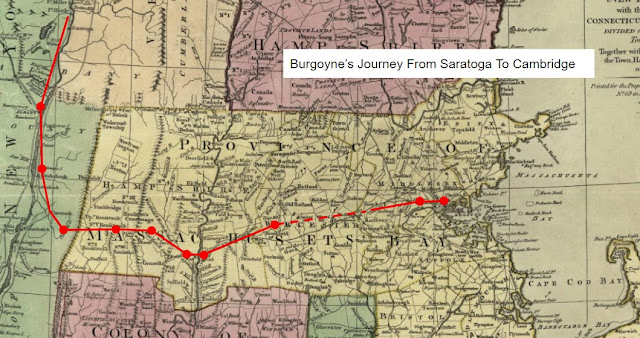
Last week I shared that tracking the 1777 journey of Lieutenant-General John Burgoyne from Saratoga to Cambridge was a challenge.  Several primary sources document he stayed in Albany at Major-General Philip Schuyler's home until October 27th, and arrived in Cambridge on November 7th.  Less clear was where he stopped in between, though multiple locations lay claim to the statement "Burgoyne slept here" - some relatively easy to challenge, others not so much so. Travelers during the Revolutionary War going from Albany to Boston (or Boston to Albany) generally followed one of two major routes that correspond to the routes taken by the British and German columns.  A traveler leaving Albany could head south towards Kinderhook, then east through Great Barrington to Springfield, and on to Boston (or Cambridge for our purposes) along the Western Post Road.  Alternatively, a traveler could head east from Albany to Pittsfield or Williamstown, then through the Berkshires to c...

Saratoga to Boston 1777 - "The Easiest, Most Expeditious, and Convenient Route"

Image
Article IV of the Articles of Convention required "The army under Lieutenant-general Burgoyne, to march to Massachusetts Bay, by the easiest, most expeditious, and convenient route; and be quartered in, near, or as convenient as possible to Boston..." Understanding the routes taken is a study of history and geography.  There is no direct natural route from Saratoga to Boston, but a well established network of roads provided a way across rivers and streams, over mountains, through woods, and past countless farms and villages.  American militia units had taken many of these roads in the summer and early fall of 1777 to join the Northern Army under Major-General Horatio Gates at Saratoga, and would use them to escort Lieutenant-General John Burgoyne's British and German troops to quarters in Cambridge and present-day Somerville (then part of Charlestown) Massachusetts to await their fate.  I'm interested in following their footsteps as closely as possible. Two accounts ...