Posts

Showing posts with the label Gates

Lieutenant Benjamin Whitcomb, Part 3 - "Its Design Is Somewhat Artful"

Image
British Brigadier General Patrick Gordon died on August 1, 1776 , a week after he was shot near St. Johns, Quebec, by American Lieutenant Benjamin Whitcomb .  Three days later Sir Guy Carleton, the commander in chief of British forces in Canada ordered: "The commanding Officers of Corps will take especial care that every one under their command be informed, that Letters, or messages from Rebels, Traitors in Arms against the King, Rioters, disturbers of the public Peace, Plunderers, Robbers, Assassins, or Murderers, are on no occasion to be admitted: That should emissaries from such lawless Men again presume to approach the Army, whether under the name of Flag of Truce Men or Ambassadors except when they come to implore the King's mercy, their persons shall be immediately seized and committed to close confinement to be proceeded against as the Law directs: Their Papers & Letters for whomsoever directed (even this Com'r in Chief) are to be deliver'd to the Provost Ma...

Signer, Negotiator, Escort - "At My Request Appointed Brigadier-General Whipple"

Image
Why did Major General Horatio Gates choose Brigadier General William Whipple as one of his two delegates to negotiate the surrender at Saratoga, and to escort Lieutenant General John Burgoyne to Cambridge? Lieutenant Colonel James Wilkinson, Gates adjutant, claimed credit for the first of these decisions.  Wilkinson wrote in his memoir that on October 15, 1777, when Burgoyne proposed two officers from each side meet: "... General [Gates] was pleased to name me as one of his representatives, and at my request appointed Brigadier-general Whipple of the militia, to accompany me..." [1]  The key to John Trumbull's painting of the surrender, shown here, identifies all three: Gates, figure 14, at its center; Wilkinson, figure 13, to the left of Gates far back in the distance; and Whipple, figure 25, in profile looking left with his left forearm on the far wheel of the cannon. Gates selection of Wilkinson as one of his two negotiators makes sense.  Wilkinson served as a voluntee...

The Surrender Celebrated - "Freedom To The Whole World"

Image
News of British Lieutenant-General John Burgoyne's surrender to Major-General Horatio Gates at Saratoga, New York, on October 17, 1777,  spread quickly .  Patriotic citizens of the young United States of America were jubilant, and celebrated in a number of ways.   Those present at the surrender noted their feelings in their journals and diaries, and the letters they sent home.  For Doctor Samuel Merrick of Massachusetts, who had seen firsthand the suffering of the troops who retreated south from Canada in 1776, it was "A day never to be forgotten by the American States. ... The Lord be praised for this wonderful token of divine favor for which we cannot be sufficiently thankfull." [1]  Colonel Ralph Cross of the Massachusetts Militia described what he saw as "... a Grand Sight as ever was Beheld by Eye of man in America."  [2]  In the habit of the times, men gathered in local taverns to toast the victory, and local newspapers reported those...

Preparing For The Surrender - "As Any Of The Most Polished Nations"

Image
Tuesday, October 17th, is the 246th anniversary of the British surrender at Saratoga.  On that day in 1777, Major-General Horatio Gates, commander of the Northern Army of the United States, ordered his soldiers to be prepared.   “The regiment of riflemen under the command of Colonel Morgan and the company of Light Infantry under the command of Major Dearborn to be ready when ordered to take possession of the enemy’s lines, posts, and redoubts. The commanding officers of those troops are to be particularly attentive to the soldierlike and good behavior of their men. The enemies of the United States have propagated an opinion among the British and German troops that the Americans are barbarians who pay no regard to the faith of treaties, and whose sole view is rapine and plunder. From the preceding glorious behavior of the army, the General is convinced that not an officer or soldier under his command will suffer the smallest infringement of the convention. Their general ha...

George Washington and Saratoga - "A Matter Of Such Magnitude"

Image
February 22, 2023, marks the 291st anniversary of the birth of George Washington, pictured here in a  Library of Congress  print published in Germany in 1777 or 1778.  For more than two centuries Washington's birth has been widely noted, and was a federally recognized holiday from 1885 to 1971.  For the last five decades an all encompassing "Presidents' Day" has supplanted not only a holiday observance on the date of Washington's birth, but the February 12th celebration of the birthday of another truly great American President, Abraham Lincoln. In the fall of 1777 Washington hands were full as commander-in-chief of the Continental Army.  While Major-General Horatio Gates defended the upper Hudson River Valley, Washington was responding to British General Sir William Howe's expedition moving not north to support Burgoyne, but south by ship into the Chesapeake Bay and then north by land to Philadelphia.  On September 11th British forces maneuvered to fla...

The Articles of Convention - "Mutually Signed and Exchanged"

Image
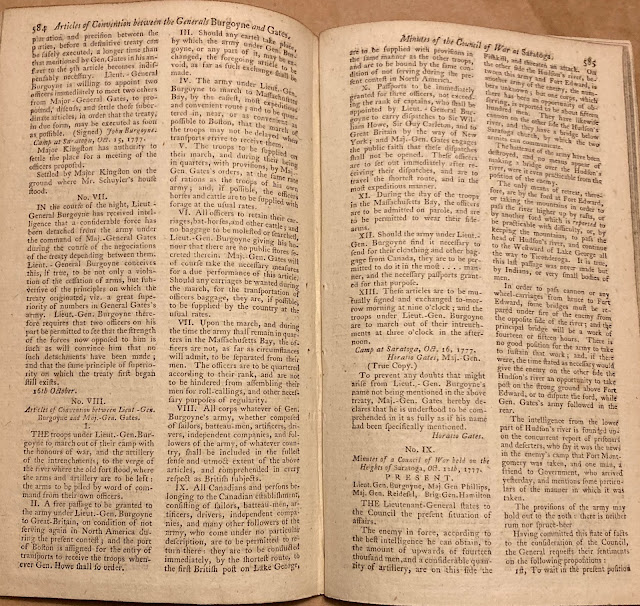
On October 14, 1777, Lieutenant-General John Burgoyne Burgoyne, commander of the British expedition to seize the Lake Champlain and Hudson River Valleys, sent a messenger to Major-General Horatio Gates, commander of the opposing American forces, to propose a cease-fire and negotiate an end to the fighting  "... to spare the lives of brave men upon honourable terms."   Gates replied that Burgoyne's men should surrender, lay down their arms, and march to New England by way of Bennington, Vermont as prisoners of war.  Burgoyne responded his men would sooner fight to the death than lay down their arms in their camp, and proposed instead that his army be given free passage to England on the condition that they not serve in North America again. [1]   Gates agreed in principle to Burgoyne's proposal on the 15th, adding that Burgoyne's troops should make ready to begin a march to Boston the following day.  Late on the night of the 15th another message reached ...