Posts

Showing posts with the label Glover

Signer, Negotiator, Escort - "At My Request Appointed Brigadier-General Whipple"

Image
Why did Major General Horatio Gates choose Brigadier General William Whipple as one of his two delegates to negotiate the surrender at Saratoga, and to escort Lieutenant General John Burgoyne to Cambridge? Lieutenant Colonel James Wilkinson, Gates adjutant, claimed credit for the first of these decisions.  Wilkinson wrote in his memoir that on October 15, 1777, when Burgoyne proposed two officers from each side meet: "... General [Gates] was pleased to name me as one of his representatives, and at my request appointed Brigadier-general Whipple of the militia, to accompany me..." [1]  The key to John Trumbull's painting of the surrender, shown here, identifies all three: Gates, figure 14, at its center; Wilkinson, figure 13, to the left of Gates far back in the distance; and Whipple, figure 25, in profile looking left with his left forearm on the far wheel of the cannon. Gates selection of Wilkinson as one of his two negotiators makes sense.  Wilkinson served as a voluntee...

Worcester, Massachusetts - "A Small Neat Town"

Image
By 1777 the central Massachusetts town of  Worcester, forty miles west of Boston, had a reputation as friendly to the patriot cause.  Residents had  shut down the courts  in September 1774, in what author Ray Raphael argues was the true start of the American Revolution.  Patriot printer Isaiah Thomas, who fled British controlled Boston in April of 1775 due to the political views expressed in his newspaper the  Massachusetts Spy , subtitled  "Or, American ORACLE Of Liberty" , published an account of the fighting on April 19th at Lexington and Concord in his  first Worcester issue  on May 3rd, 1775.  Worcester residents had served as militiamen and Continental soldiers in the Northern Army that had stopped British Lieutenant-General John Burgoyne and his army - and allegedly one of his messengers.  Like many Massachusetts towns though, it was also home, or   once home, to Loyalists  a s well.   On October 22, 1777,...

General Burgoyne Continued - "Attended Mr. Burgoyne To Boston"

Image
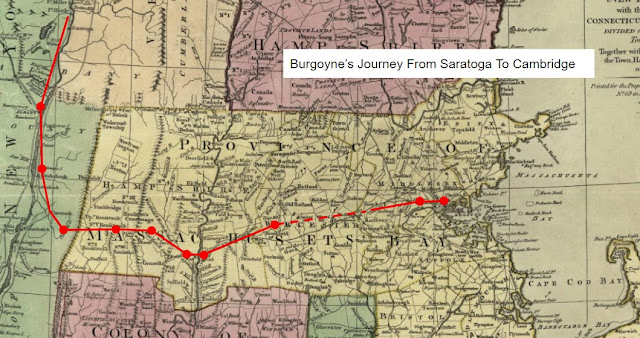
Last week I shared that tracking the 1777 journey of Lieutenant-General John Burgoyne from Saratoga to Cambridge was a challenge.  Several primary sources document he stayed in Albany at Major-General Philip Schuyler's home until October 27th, and arrived in Cambridge on November 7th.  Less clear was where he stopped in between, though multiple locations lay claim to the statement "Burgoyne slept here" - some relatively easy to challenge, others not so much so. Travelers during the Revolutionary War going from Albany to Boston (or Boston to Albany) generally followed one of two major routes that correspond to the routes taken by the British and German columns.  A traveler leaving Albany could head south towards Kinderhook, then east through Great Barrington to Springfield, and on to Boston (or Cambridge for our purposes) along the Western Post Road.  Alternatively, a traveler could head east from Albany to Pittsfield or Williamstown, then through the Berkshires to c...