Signer, Negotiator, Escort - "At My Request Appointed Brigadier-General Whipple"
Why did Major General Horatio Gates choose Brigadier General William Whipple as one of his two delegates to negotiate the surrender at Saratoga, and to escort Lieutenant General John Burgoyne to Cambridge?

Gates selection of Wilkinson as one of his two negotiators makes sense. Wilkinson served as a volunteer in Thompson's Pennsylvania Rifle Battalion in September 1775, and beginning in November on the staff of generals Nathaniel Greene and Benedict Arnold before he began working for Gates and became his deputy adjutant on May 24, 1777. [2] Wilkinson interacted closely with Gates as his adjutant, writing out orders and letters, carrying messages, and, according to Wilkinson's account of his service, offering Gates comment and advice whether he was asked for it or not. [3]
Wilkinson didn't say why he recommended Whipple as the second negotiator at Saratoga. Whipple wasn't the next senior officer in the Northern Army after Gates. While the two major generals serving under Gates had been wounded prior to Burgoyne's request for a cease-fire, Benedict Arnold on October 7, and Benjamin Lincoln on October 8, the five brigadier generals of the Continental Line in the Northern Army ranked above Whipple. [4]
It's not clear how much contact, if any, Whipple had with Gates at Saratoga prior to negotiating the surrender. Whipple was a relatively late arrival to the Northern Army (but not the latest, see Brickett's Brigade At Saratoga for that). On October 2 Whipple was placed in command of the New Hampshire militia brigade mustered in September and was ordered to "put yourself and troops under the commander in chief of the Continental army in that [Northern] department, to act as occasion may require." [5] Whipple's brigade was positioned on the east bank of the river, across the Hudson from Gates headquarters. Whipple noted in his journal that as he approached Saratoga he “... was ordered to take front at Batten Kill” on October 10, and that at the Battenkill they "... threw up a Breastwork & mounted a six pounder..." on October 12, and the following day "a firing between the two armies still continues". [6]
Whipple did not mention in his journal that he was one of the two American delegates who negotiated the terms of surrender. "Tuesday 14[th]" he wrote, "a flagg from Gen'l Burgoyne with some proposals for Treaty in consequence of which a cessation of arms --- Wednesday 15th Treaty still continues & Hostilities still cease --- Thursday 16th last evening Articles of Capitulation were agreed on by Delegates from the Contending Commanders to be Ratified at 9 o'clock this morning but Mr. Burgoyne has been quibbling & in consequence it is put off to 12 at which time Hostilities are to commence if the the terms are not agreed on by Mr. Burgoyne". [7] Wilkinson's only mention of Whipple's role in the negotiation is that he and Whipple met with Burgoyne's representatives in a tent "pitched between the advanced guards of the two armies, on the first bank just above General Schuyler's saw mill... ". There, "Having produced and exchanged credentials, we proceeded to discuss the objects of our appointment, and at 8 o'clock, P.M. we signed and exchanged articles of capitulation, and separated to report to our respective Generals." [8]
On October 17, the day of the surrender, Wilkinson noted that he rode with Burgoyne to meet Gates "... and as soon as the ceremony was concluded, I left the party and returned to the British camp, to establish guards, take an account of the ordnance and give orders for the march of the prisoners.” Wilkinson doesn't say what orders he gave or mention who would accompany Burgoyne's army to Massachusetts. [9]
Gates's choice of generals to escort Burgoyne and his army was limited. Geography would drive Gates decision. His Continental Army brigades and the militia regiments remaining in service were needed to deal with the British threat against Albany from New York City, and the remainder of Burgoyne's army to his north at Lake George, Fort Ticonderoga and Mount Independence. Brigadier General John Glover, who commanded a Continental brigade and lived in Marblehead, Massachusetts, was returning home sick. Assigning him to accompany Burgoyne and coordinate the march of five thousand prisoners made effective use of a competent general.
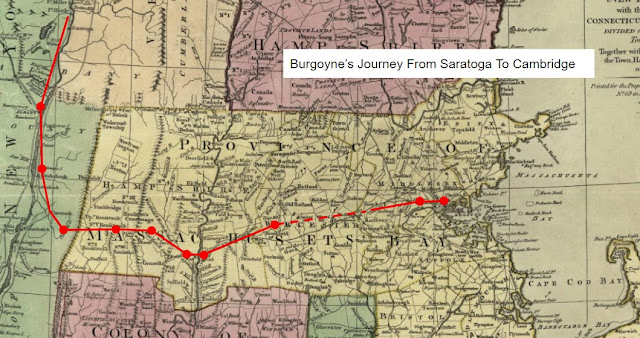
Two of his militia brigade commanders whose service was completed were heading east, Whipple, to Portsmouth, New Hampshire, and James Brickett to Haverhill, Massachusetts. Both of them, along with Glover, accompanied elements of the Convention Army and its commander from Saratoga to Cambridge, although Gates mentioned only two in his message to the Massachusetts Council, writing: "General Glover and General Whipple, with a proper guard of militia, escort them..." [10]
Selecting Whipple to negotiate on his behalf, and Whipple over Brickett to escort Burgoyne to Cambridge may have been rooted in Gates respect for social status. Perhaps he felt that Whipple, as a delegate to the Continental Congress and signer of the Declaration of Independence in 1776 was closer to par with Burgoyne, a member of Parliament.
1777 March Blog Home Overnight Stopping Points Towns and Villages Along the Way
General Whipple's Journal Burgoyne in Albany Annotated Bibliography
[2] Francis B. Heitman, Historical Register of Officers of the Continental Army (The Rare Book Shop Publishing Company, 1914), 592.
[3] Wilkinson, Memoirs of My Own Times, 1:298-299. At Saratoga, he wrote in his memoir: "Returning to our hovel on the night of the 13th, after posting the guards, the General, who had been asleep, awoke, and desired me to read [a request that Gates meet with a British officer representing Burgoyne, and Gates reply]... After the perusal of them, I asked him whether he had not condescended improperly in agreeing to receive the deputy of his adversary at his head quarters, within his guards, and between the lines of his army? After a minute's reflection he replied, 'You are right, young man; I was hasty; but what's to be done?' 'I will meet the flag,' said I, 'and endeavour to draw the message from the officer; but if he claims your engagement, he must be admitted.' 'Agreed,' said he, 'do so;...'."


Comments
Post a Comment