Posts

Showing posts with the label Surrender

Signer, Negotiator, Escort - "At My Request Appointed Brigadier-General Whipple"

Image
Why did Major General Horatio Gates choose Brigadier General William Whipple as one of his two delegates to negotiate the surrender at Saratoga, and to escort Lieutenant General John Burgoyne to Cambridge? Lieutenant Colonel James Wilkinson, Gates adjutant, claimed credit for the first of these decisions.  Wilkinson wrote in his memoir that on October 15, 1777, when Burgoyne proposed two officers from each side meet: "... General [Gates] was pleased to name me as one of his representatives, and at my request appointed Brigadier-general Whipple of the militia, to accompany me..." [1]  The key to John Trumbull's painting of the surrender, shown here, identifies all three: Gates, figure 14, at its center; Wilkinson, figure 13, to the left of Gates far back in the distance; and Whipple, figure 25, in profile looking left with his left forearm on the far wheel of the cannon. Gates selection of Wilkinson as one of his two negotiators makes sense.  Wilkinson served as a voluntee...

The British Experience - “Two Hundred Miles From Saratoga To Boston”

Image
When I last wrote about  what the Convention Army looked like , I indicated that I was not aware of any image depicting the 1777 march.  Since then I've come across one, in a 1778 British political cartoon in the Library of Congress entitled  "The Closet" .  It shows, among other things, King George III with several of his advisors, and two panels labeled "Saratogha" [sic].  One of the Saratoga panels, pictured here, shows a column of soldiers marching off into captivity, hands bound, as American troops look on from a distance. Their commander, Lieutenant-General John Burgoyne, leads his men sword in hand , and a copy of his play "Maid of the Oaks" under one arm and book of poems under the other, and remarks of his downcast followers:  "I have led my Rag-o-muffians where they have been Peppered" . While there is nothing that suggests this image was drawn from life, especially since Burgoyne rode to meet Gates at his headquarters before depart...

Burgoyne Surrenders - "The Generals In America Doing Nothing, Or Worse Than Nothing"

Image
Thursday, October 17, 2024, is the 247th anniversary of British Lieutenant-General John Burgoyne's surrender at Saratoga, New York.  The final days of his failed campaign are being remembered during "Siege Weekend" on October 12th and 13th at Saratoga National Historical Park , and a variety of other locations listed on the Saratoga 250 Events Page .  A month-long program of events, beginning with the Battle of Freeman's Farm, culminates on the 17th in a community remembrance of the surrender  at 10:00 AM at Fort Hardy Park in Schuylerville, New York, Saratoga National Historical Park rangers at the site where Burgoyne surrendered  about a mile south of Fort Hardy on Route 4, and at 6:00 PM, a "Surrender Day Benefit" in Saratoga Springs .  For those who like to plan ahead, 2025's commemoration of "Victory Season at Saratoga" is already on the Saratoga 250 website. Looking back, one of the earliest images of Burgoyne's surrender appears to...

Commemorating The Revolution - "A Day Never To Be Forgotten [And More]"

Image
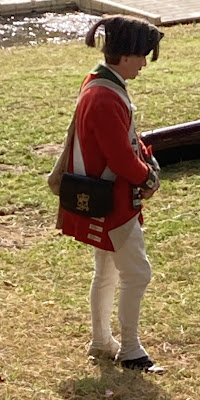
Reenactors, scholars and historians will remember the Revolutionary War with a variety of events in September and October of 2024.  Several will commemorate Lieutenant-General John Burgoyne's failed 1777 campaign, including his surrender on October 17th, as shown in this photo taken last year at a recreation of the event in Schuylerville, New York. September and October are great months to visit historic sites in New York and New England.  First up on my list is "Soldiers on the Mount", on Labor Day weekend at Mount Independence, a Vermont State Historic Site in Orwell, Vermont .  Several reenactor groups will camp out there to portray the American occupation of the site from July 1776 through July of 1777.  Site staff are organizing what they call their "Walkabout" on Saturday, August 31st.  This will feature a number of reenactors and historians at several points along the site's Baldwin Trail, who will interact with visitors on a variety of topics. ...

Yankee Doodle - "Ev'ry Rebel Fife In Play"

Image
This week's celebration of the anniversary of the United States declaring it's independence seems as good a time as any to share a story about the writing of the song "Yankee Doodle", and its connections to the  surrender at Saratoga  on October 17, 1777, and the 1777 march of the Convention Army.   There are a number of claims that the song was played by victorious American musicians when the army of Lieutenant-General John Burgoyne surrendered at Saratoga.  One comes from a footnote in a collection of accounts of visits to the battlefield by William L. Stone which reads: "The piling of the arms was, it is true, done amid profound silence and without any attempt to humiliate the British.  The instant, however that the march southward began, the American bands struck up "Yankee Doodle".  ... This song had been set to music by a facetious English surgeon at Lake George during the French war..." [1]  Stone’s earlier work,  Ballads and Poems Re...

A Stand Of Arms - "What Is Become Of The Cartouch Boxes"

Image
Lieutenant-General John Burgoyne's British and German soldiers left their camp on the morning of October 17, 1777, with orders to march "... to the verge of the river where the old fort stood, where the arms and artillery are to be left; the arms to be piled by word of command from their own officers." [1]  Following the surrender, American Colonel Jeduthan Baldwin would record in his diary that among what was captured were "5000 Stands arms" , or as Lieutenant-Colonel James Wilkinson would quote  decades later  from Major Ebenezer Steven's return: "five thousand stand of arms are taken ..."  [2]     What is a stand of arms?  The term does not appear in Thomas Simes " A Treaty on the Military Science" .   Captain George Smith's  Universal Military Dictionary  helps some, as  "Stand of Arms"  is defined as being  "a complete set of arms for one soldier."   What is meant by "arms" though is open t...

Muskets - "Five Thousand Stand Of Arms Are Taken"

Image
Article I of the Articles of Convention required Lieutenant-General John Burgoyne's British and German soldiers to "march out of their camp" on the morning of October 17, 1777, "... to the verge of the river where the old fort stood, where the arms and artillery are to be left; the arms to be piled by word of command from their own officers." [1]   Burgoyne was very specific with regard to this point.  On October 14th, Major-General Horatio Gates had proposed to Burgoyne that once terms were agreed to, "... the troops under his excellency General Burgoyne's command, may be drawn up in their encampment, when they will be ordered to ground their arms, and may thereupon be marched to the riverside, to be passed over on their way towards Bennington."   [2] Burgoyne initially replied to Gates: "If General Gates does not mean to recede from the first [Burgoyne's troops surrender as prisoners of war] and sixth [Burgoyne's troops ground th...

Burgoyne's Artillery - "Drawn Through The Village"

Image
Lieutenant-General John Burgoyne's British and German troops marched out of their camp and entrenchments at Saratoga on the morning of October 17, 1777, and left their arms and artillery at  "the verge of the river where the old fort stood."  [1]   Supposedly, "With a moist eye the artilleryman looked for the last time upon his faithful gun parting with it as he would from a bride - and that, forever!"  [2]  For the American army, the surrendered artillery was something to be secured, inventoried, and redistributed for use in future battles against their former owners.   A German office would note:  "England's greatest loss may be considered the loss of the  artillery, which was taken by the rebels."  - though Britain's loss of an army, the boost to American morale, and the resulting alliance between the United States and France was surely more significant. [3]   An account of  the Convention Army's stop in Great Barr...