Saratoga Connections To The Declaration Of Independence - "We Arrived In The Evening"
Half a century ago, as the United States prepared to celebrate its two hundredth birthday, New York historian Paul Scudiere began the introduction to his biography of New York's signers of the Declaration of Independence with the statement: "The most important single event in the history of the American nation was the adoption of the Declaration of Independence by the Continental Congress on July 4, 1776." He went on to point out: "Although New York played a key role in the winning of independence and in the establishment of American democratic government, the New York delegates then in Congress did not vote on Richard Henry Lee's resolution 'that these United Colonies are and of right ought to be, free and independent states,' on July 2, 1776, nor on the Declaration itself when it was considered two days later." [1]

Historians tell us the Declaration of Independence was not signed on July 4, and the process of signing didn't look anything like what was famously pictured by John Trumbull half a century later (as seen here). Rather, Congress responded to Lee's June 6 resolution by appointing a committee made up of five of its members, including Benjamin Franklin, to draft a statement of independence. On July 2, as Scudiere wrote, Congress approved that section of Lee's resolution calling for independence, and on July 4 the Declaration of Independence itself. [2]
Congress had the text of the Declaration printed immediately after it was passed, and multiple copies were sent to each of the colonies where it was printed and read to the public (leading to the claim it was first read to the public in New England by Isaiah Thomas). Two weeks later, on July 19, Congress ordered that the Declaration be written out on parchment and signed by each of its members. The engrossed copy of the Declaration, seen below, was not ready to sign until August. The process of signing began on August 2 with John Hancock, but it was several months at least before the last signatures were added. [3]

Carroll wrote in his journal that on April 9: "We arrived in the evening a little before sunset at Saratoga, the seat of Gen. Schuyler... The lands about Saratoga are very good, particularly the bottom lands. Hudson's River runs within a quarter of a mile of the house... A stream called Fish Kill, which rises out of Lake Saratoga about 6 miles from the General's house, was close by it and turns several mills...". [5]
Carroll's journal as printed ends on June 10, 1776, with his arrival in Philadelphia. A Maryland State Archives biography of Carroll notes that because he was a Catholic, he initially attended Congress as an unofficial observer and advisor and did not become official delegate until July 4, 1776. As a result, while Carroll signed the Declaration he did not vote on the resolution for independence or approval of the Declaration itself. [6]
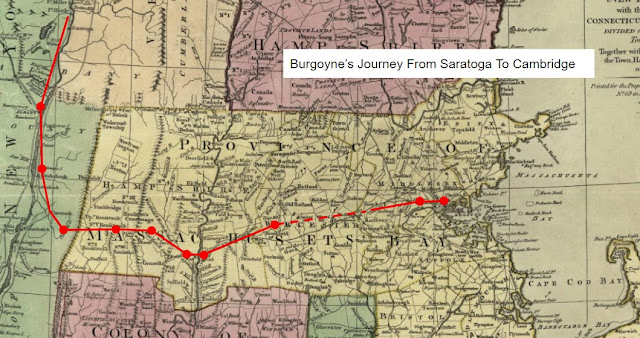
Whipple was in Philadelphia in 1776 and did vote for independence. His journey to Saratoga came a year later. He arrived in the Saratoga area on October 9, 1777, as the commander of a New Hampshire militia brigade and left on October 18 to escort British Lieutenant General John Burgoyne to Cambridge, Massachusetts, following his surrender. One of Whipple's first observations when he arrived was that the American forces north of Burgoyne's army had withdrawn to the east bank of the Hudson River as they lacked "... sufficient force to face the Enemy when they took possession of the Schuyler house...", the same house where Carroll, Franklin and Chase stayed in April - and Burgoyne had burned the day after Whipple made his observation. [7]
Ironically, while Whipple would vote in July of 1776 that "We hold these truths to be self-evident, that all men are created equal...", he traveled to both Philadelphia and Saratoga with an enslaved Black man, Prince Whipple, who would not see personal freedom until 1784, and never enjoyed full equality during his lifetime. [8]
Philip Schuyler, whose country home Carroll referred to, was a member of the Continental Congress in 1776, but he like the rest of the New York delegation didn't vote for independence. Schuyler was not in Philadelphia when the vote was taken as he was dealing with military issues in the Champlain Valley. As to those delegates from New York who were in Philadelphia and didn't vote for independence, it wasn't that they disagreed with the resolution. It was simply that New York's delegates had not received authorization to do so at the time the vote was taken. [9]
1777 March Blog Home Overnight Stopping Points Towns and Villages Along the Way
General Whipple's Journal Burgoyne in Albany Annotated Bibliography
[2] This sequence of events led John Adams to write to his wife Abigail on July 3: "The Second Day of July 1776, will be the most memorable Epocha, in the History of America. I am apt to believe that it will be celebrated, by succeeding Generations, as the great anniversary Festival. It ought to be commemorated, as the Day of Deliverance by Solemn Acts of Devotion to God Almighty. It ought to be Solemnized with Pomp and Parade with Shews, Games, Sports, Guns, Bells, Bonfires and Illuminations from one End of this Continent to the other from this Time forward forever more." https://www.masshist.org/publications/adams-papers/index.php/view/ADMS-04-02-02-0016
[3] Emily Sneff's book "When the Declaration of Independence Was News" is an outstanding account of how Congress disseminated the text of the Declaration, and well worth reading as we celebrate the 250th anniversary of its adoption.


Nice article
ReplyDelete