How well recognized was Henry Knox for his journey to Ticonderoga and return to Cambridge?
On November 16, 1775, General George Washington tasked twenty-five-year-old Henry Knox (seen here in a 1778 painting by Charles Wilson Peale, from the collection of the Metropolitan Museum of Art), a bookseller from Boston, Massachusetts, to travel to New York and bring back artillery, ammunition and gun flints for the Continental Army which surrounded British occupied Boston.
The story of Knox's return from Fort Ticonderoga with his "Noble Train of Artillery" is fairly well know today. Two hundred and fifty years ago only a few seemed to have taken note of what he did. Many still overlook the first two parts of his mission.
Washington's instructions first directed Knox "... to examine into the state of the artillery of this army, and take an account of the cannon, mortars, shells, lead, and ammunition, that are wanting."
Next, Knox was "... to proceed in the most expeditious manner to New York, there apply to the President of the Provincial Congress... to procure such of them as can possibly be had there. The President, if he can, will have them immediately sent hither...".
It was only then, "
After you have procured as many of these necessaries as you can there [in New York City], you must go to Major-General Schuyler, and get the remainder from Ticonderoga, Crown Point, or St. John’s; if it should be necessary, from Quebec, if in our hands. The want of them is so great, that no trouble or expense must be spared to obtain them." [1]
One month later, Washington was anxiously waiting for Knox to return. On December 14, 1775, he wrote to John Hancock: "I hope Colonel Knox will soon finish the business he is upon, and appear here to take the honorable command conferred on him by Congress.". [2] On December 24 he wrote to Major General Philip Schuyler, saying: "I hope soon to hear, that Colonel Knox has made good progress in forwarding the artillery. It is much wanted for the works we have lately thrown up." [3] On January 16, 1776, two months after he ordered Knox to go to New York, Washington wrote to Schuyler again saying: "I am much pleased that the artillery was like to be got over the river, and am in hopes that Colonel Knox will arrive with it in a few days. It is much wanted." [4]
One might expect that
Knox's return to Cambridge would be noted by Washington, as were other military accomplishments. Two days before Knox received his orders, Washington announced in his general orders to the Continental Army
"... the glorious Success of Continental Arms, in the Reduction, and Surrender, of the Fortress of St. Johns [in Canada]." On November 28, 1775, he announced
"An Express last Night from General Montgomery, brings joyful tidings of the Surrender of Montral...". On January 9, 1776, Washington thanked
"Major Knowlton, and the Officers and Soldiers, who were under his command last night; for the Spirit, Conduct and Secrecy, with which they burnt the Houses near the Enemy's works, upon Bunker Hill...". On March 8, 1776, he thanked the militia
"for their spirited and alert march to Roxbury..." when they were called out on an alarm. Far more frequently though Washington's orders addressed the struggles he faced re-organizing the Continental Army, and the outcome of numerous courts martial for countless infractions. [5
].
Knox's name appears just four times in the orderly book of Colonel William Henshaw, an assistant adjutant general under Horatio Gates, in the months from December 1775, through March of 1776. On December 12, Knox's appointment as colonel of artillery was announced to the army. On February 7, 1776, it was announced that a chaplain had been appointed for Knox's and another regiment. On February 17, Knox was ordered to report on the number of artillery cartridges ready for use, and on March 31, after the British had left Boston, he and his regiment were ordered to march to New York City with Brigadier General Joseph Spencer's brigade. [6]
Colonel Jeduthan Baldwin, one of Washington's engineers, does not mention Knox during the siege of Boston in his journal. On December 11, 1775, Baldwin noted the completion of fortifications on Cobble Hill. On the 16th he staked out a fort at Lechmere Point, where on the 26th he "Laid a platform for the Great Morter...", followed by another platform on the 29th, and the cutting of two embrasures (openings for cannon in the wall of a fort) on the 30th. Baldwin must have been in a position to hear the news, as in addition to his duties as an engineer, he dined with Generals Putnam and Washington on December 25, and then "Washington & Lady" (Martha Washington) on December 26. [7]
Given Baldwin's roll in constructing fortifications, it seems reasonable to assume he would take note of the arrival of nearly sixty cannons, howitzers and mortars, but he doesn't. On January 18, 1776, Baldwin noted: "Recd. the news of the Death of Genl. Magomery [Montgomery] & others before Quebeck ye 30 of Decr." Following a brief visit to his home in Brookfield, Massachusetts, in early February (a town along the route Knox is credited with taking), he returned to camp February 10 and continued to work on fortifications in Cambridge and at Roxbury. On March 2, he "... went upon Dotchester Hills with ye Generals recd. there Instructions...", and the following day noted "... had everything in readiness for taking post at Dotchester...", where on March 4: "... the army Came on at dusk with 280 carts & wagons with materials for the fortifications." [8]
It would not be until eight months later, on August 2, 1776, that Baldwin finally mentioned the artillery taken from Fort Ticonderoga to Cambridge, but not Henry Knox. That day, Baldwin noted in his diary: "this morning I went early to Independant Point [Mount Independence, Vermont] where we Charged the other 13 inch mortar, by way of tryal, when she was fired she burst...", as had one fired the day before. Both mortars Baldwin noted "were carried from this place to Cambridge & brought back & went Down to Canada & then back to this place, at an immense cost, altho they were worth nothing." [9]
What contemporary mention there was of Knox is brief. Brigadier-General Nathanael Greene of Rhode Island, in a long letter to his sister-in-law Catherine Ward Greene dated January 13, 1776, included one sentence reading "A large Artillery is expected in a few Days.", likely a reference to Knox's pending arrival. [10] Knox's role does not appear to have been kept secret. Future president John Adams traveled to Framingham less than two weeks later, and wrote in his diary: "1776. Jany. 25. Thursday. About 10 Mr. Gerry called me, and we rode to Framingham, where We dined. Coll. Buckminster after Dinner shewed us, the Train of Artillery brought down from Ticonderoga, by Coll. Knox..." [11]
Knox's journey to Ticonderoga received little recognition in the first few decades after the war. William Heath, a brigadier-general at the time, wrote in his memoir first published in 1798 that on January 18, 1776: "Col. Knox, of the artillery, came to camp. He brought from Ticonderoga a fine train of artillery, which had been taken from the British, both cannon and mortars, and which were ordered to be stopped in Framingham.". [12] Mercy Otis Warren, the author of a three volume History of the Rise, Progress and Termination of the American Revolution, published in 1805, did not mention of Knox's journey to Ticonderoga in the winter of 1775. She, like so many others, focused her attention on the attack on Canada and the death of Montgomery. James Wilkinson (Gates adjutant at Saratoga) made no substantive mention of Knox in his multi-volume memoir of his own life until December of 1776. It was then, at the Battle of Trenton, he wrote that: "Boats were in readiness, and the troops began to cross about sunset, but the force of the current, the sharpness of the frost, the darkness of the night, the ice which made during the operation, and a high wind, rendered the passage of the river extremely difficult; and but for the stentorian lungs and extraordinary exertions of Colonel Knox, it could not have been effected in season to favour the enterprize...". [13]
Doctor James Thacher, who served as a surgeon in the Continental Army for much of the war, made no mention of Knox or the artillery taken from Fort Ticonderoga in his memoir. Regarding the army's artillery, he wrote: "Before our privateers had fortunately captured some prizes with cannon and other ordnance, our army before Boston had, I believe, only four small brass cannon, and a few old honey-comb iron pieces, with their trunnions broken off...". In November of 1775 he noted: "The joyful intelligence is now announced in the public papers, that Captain Manly, of. Marblehead, commander of one of our privateers, has captured an English ship, bound to Boston, loaded with ordnance stores, of immense value at the present time. Among the ordnance is a large brass mortar on a new construction; and a number of pieces of fine brass cannon. ...". Shortly after, he wrote: "[On] December 2d.—I visited the park of artillery, and was much gratified to find a collection of ordnance far exceeding my expectations, and such as is supposed by some to be adequate to our present exigence. I had a view of the large brass mortar taken by Captain Manly; it is now called the Congress, and will soon be prepared to speak in strong terms to its former masters." [14]
Thacher provides a detailed description of the final days of the siege of Boston but still no mention of Knox by name, or the artillery from Ticonderoga, noting: "March 2d.—A very heavy discharge of cannon and mortars commenced from all our works at Cambridge and Roxbury. 3d.—The firing from our works continues, but the great brass mortar, the Congress, and two others, have unfortunately burst; which is exceedingly regretted. 4th. - The object in view is now generally understood to be the occupying and fortifying the advantageous heights of Dorchester. ... the preparations are immense; more than three hundred loaded carts are in motion. By the great exertions of General Mifflin, our Quarter Master General, the requisite number of teams has been procured. The covering party of eight hundred men advance in front. Then follow the carts with the entrenching tools; after which, the working party of twelve hundred, commanded by General Thomas, of Kingston. Next in the martial procession are a train of carts, loaded with fascines and hay, screwed into large bundles of seven or eight hundred weight." [15]

It's not clear to me when the story of Henry Knox and his "Noble Train of Artillery" was first celebrated. A century and a half later, bronze plaques set into granite were placed along the route they were believed to have taken through New York and across Massachusetts. During the bicentennial, a group of reenactors with wagons and draft animals followed the entire route of his journey. In many towns local reenactors joined that column for the day, as seen here in Worcester in January of 1976. This year, in commemoration of the two-hundred and fiftieth anniversary of Knox's passing, a series of events in some of those same communities along that route are celebrating once again what Knox and his men accomplished.
Next Time: Mocked By His Own Words - "Elbow Room"
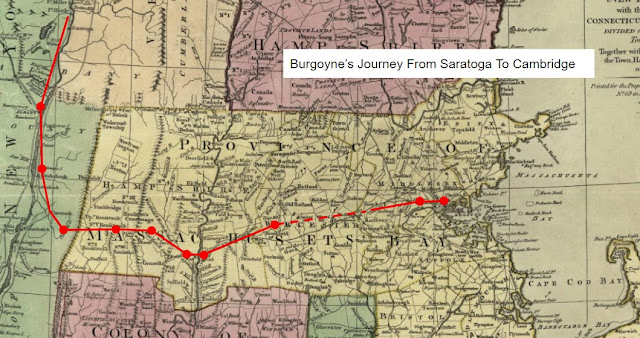
For more on the Convention Army's 1777 march from Saratoga to Boston, see:
1777 March Blog Home Overnight Stopping Points Towns and Villages Along the Way
General Whipple's Journal Burgoyne in Albany Annotated Bibliography
[5] John C. Fitzpatrick, ed., The Writings of George Washington (Washington, DC: United States Government Printing Office, 1931), 4:87, 119, 223-224, and 384.
[6] William Henshaw, The Orderly Books of Colonel William Henshaw (Worcester, MA: Davis Press, 1948), 58, 83, 89 and 109.
[7] Jeduthan Baldwin, The Revolutionary Journal of Colonel Jeduthan Baldwin 1775-1778 (North Stratford, NH: Ayer Company, 2001), 17-20.
[8] Baldwin, Journal, 17-30. After noting on March 14 "... many things ought to have been noticed from the 4th Day of March to this time which in a hurry have been omitted..", his next entry was made on March 20, when he began his way to New York City.
[9] Baldwin, Journal, 64.
[10] Nathanael Greene, Richard K. Shumway, ed., The Papers of General Nathanael Greene (Chapel Hill, NC: University of North Carolina Press, 1976), 1:183. Two sentences earlier he told her "They [the British in Boston] are greatly distressed, reduced to the necessity of Eating Cats and Dogs."
[11] William Heath, Heath's Memoirs of the American War (New York, NY: A Wessels Co., 1904) 45-46. Heath earlier noted that Knox went to Ticonderoga to bring back artillery to Boston, but in the context of summarizing the capture of the fort. (Heath, 36.)
[13] James Wilkinson, Memoirs of My Own Times (Philadelphia, PA: Abraham Small, 1816), 1:128. Wilkinson, bitter at how he had been treated and critical of many, does mention Knox in his introduction, but in a diatribe on how the "War Department" had lost its way, writing: "The pay department, if possible the most defective and the most corrupt of all... [it] was deranged by General Knox in a moment of personal favoritism, about twenty-five years since, and we seem to have lost the art, however simple, to cure the defects, which would save an hundred thousand dollars expense, and would produce incredible effects on the morals, manners, police, discipline, comfort, and health of the troops, subjects little understood, and perhaps less regarded; under existing ordinances and arrangements, the commanding officers of companies neither can nor ought to be strictly responsible for the fitness of their men in the various, moral, and physical relations to the service."
[14] James Thacher, MD, A Military Journal During the American Revolutionary War (Boston, MA: Cottons & Barnard, 1827), 36-37.
[15] Thacher, Journal, 40.


Great post, interesting historigraphy .
ReplyDelete