Colonel Henry Knox: Springfield To Cambridge - "Brought Down From Ticonderoga"
Where was Henry Knox between January 13 and January 18, 1776?
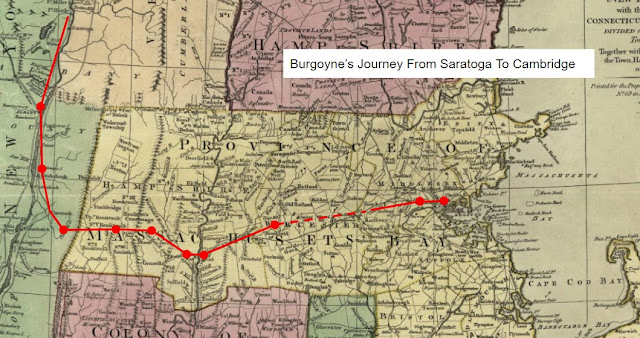
On November 16, 1775, General George Washington tasked twenty-five year old Henry Knox, a bookseller from Boston, to travel to New York and bring back artillery, ammunition and gun flints for the Continental Army which surrounded British occupied Boston. Knox's "Noble Train of Artillery", like the Convention Army, passed through dozens of towns and villages on its way south from Fort Ticonderoga in New York, and then east across Massachusetts. [1] After crossing Lake George, and reaching Saratoga, it followed the route taken by British Lieutenant-General John Burgoyne after his surrender on October 17, 1777, and the German column, once it reached Greenbush, for much of the way.

Knox's journey through Massachusetts (and New York) is noted by a series granite markers with bronze plaques in the towns he is thought to have passed through. East of Springfield, Massachusetts, there are markers in the towns of Wilbraham, Palmer, Warren (Western in 1775), Brookfield (which subsequently has become the towns of Brookfield, West Brookfield, North Brookfield and East Brookfield), Spencer, Leicester (the site of the marker pictured here), Worcester, Shrewsbury, Northborough, Marlborough, Southborough and Framingham; as well as Wayland (part of Sudbury in 1775), Weston, Waltham and Watertown. [5]
Worcester's newspaper, the Massachusetts Spy, made no mention of Knox or his artillery passing through town. The front page of its January 19, 1776, edition ran a notice from Horatio Gates, Adjutant-General of the Continental Army, informing all who were away from camp they were required to return by February 1. Inside, readers learned of the failed attack on Montreal, which resulted in the death of General Montgomery and the capture of Major Timothy Bigelow of Worcester. Two weeks later the paper ran a list of "Remarkable Events in the Year 1775". Henry Knox's journey was not among them, but number twelve on the list was that "General Burgoyne came over to America 'to cure the Gentlemen and to dance the Ladies into submission to the British Parliament,' and to 'temper his punishments with humanity', lived six months upon salt meat, wrote two letters, the one (for Gen. Gage) to Gen. Washington, in which he destined our prisoners to the cord [to be hung], the other, to a noble Lord in England, both in heorics [sic]. Did not inflict a single punishment upon an American nor dance with one of our Ladies - got into a passion - and went home again." [6]
The Reverend Ebenezer Parkman, who lived in Westborough, just south of the marked route from Shrewsbury on to Framingham, did not mention Knox's passing in his diary, which spans the years 1719 through 1782. Parkman's role as the town's minister connected him to most everyone in the community, and whatever news they had. On November 14, 1775, two days before Knox received his orders to go to New York, Parkman noted "St. Johns on Lake Champlain [sic], is taken". On December 16 he heard of "Many Successes of the provincial Forces... and of taking Montreal". On December 24 he learned that three children drowned in Worcester, "skating on the ice, which broke and let them into the Water", a risk that Knox was all too well aware of.
On December 29 Parkman learned that an American privateer had captured a British ship loaded with ordnance stores which were bound for Boston. On January 18, 1776, he too would note: "Sorrowful News from Quebeck - General Montgomery Slain". On March 4, with still no mention of Knox or any of the artillery from Ticonderoga passing through the area, Parkman noted: "Divers persons heard many Guns firing last night as if there were some Attempt from [illegible] on Boston." [7]
On January 18, 1776, Brigadier General William Heath noted in his memoir first published in 1798: "Col. Knox, of the artillery, came to camp. He brought from Ticonderoga a fine train of artillery, which had been taken from the British, both cannon and mortars, and which were ordered to be stopped in Framingham." [8] Future president John Adams traveled to Framingham one week later, writing: "1776. Jany. 25. Thursday. About 10 Mr. Gerry called me, and we rode to Framingham, where We dined. Coll. Buckminster after Dinner shewed us, the Train of Artillery brought down from Ticonderoga, by Coll. Knox. It consists of Iron—9 Eighteen Pounders, 10 Twelves, 6. six, four nine Pounders, Three 13. Inch Mortars, Two Ten Inch Mortars, one Eight Inch, and one six and an half. Howitz,2 one Eight Inch and an half and one Eight. Brass Cannon. Eight Three Pounders, one four Pounder, 2 six Pounders, one Eighteen Pounder, and one 24 Pounder. One eight Inch and an half Mortar, one Seven Inch and an half Dto. and five Cohorns." [9]
While some accounts of Knox's "Noble Train" claim the American army had no artillery until the guns from Ticonderoga reached Cambridge (by way of Framingham), that's a bit of an exaggeration. Heath for example wrote that on December 5, 1775 "Two 18 pounders were brought from Roxbury, and mounted at Cobble Hill." [10] What effect these guns may have had is an open question, as the diary of William Cheever, a merchant in British occupied Boston indicates: "18th. [December 1775] ... to day the Provincials threw an eighteen lb. Shot into Town which struck upon Dr. Lloyd's Hill without killing any one." [11]
We can only speculate as to why we don't have a timeline for Knox's journey east of the Connecticut River. Perhaps Knox's diary ends because he was too worn out to continue making entries. Perhaps those along the route were too pre-occupied by other events - particularly news regarding the American invasion of Canada - to take notice of their passing, or Knox took precautions to hide what he was doing. Regardless, we are told the artillery Knox delivered to Washington played a key role in driving the British out of Boston - something to look at next time...
1777 March Blog Home Overnight Stopping Points Towns and Villages Along the Way
General Whipple's Journal Burgoyne in Albany Annotated Bibliography
[2] Henry Knox to George Washington, January 5, 1776, https://founders.archives.gov/documents/Washington/03-03-02-0019
[3] Henry Knox Diary, 20 November 1775 - 13 January 1776, Massachusetts Historical Society, https:/,/www.masshist.org/database/viewer.php?item_id=463&pid=15.


Comments
Post a Comment