Colonel Henry Knox: Albany to Westfield - "Almost A Miracle"
On November 16, 1775, General George Washington instructed twenty-five year old Henry Knox, a bookseller from Boston, to travel to New York. [1] He was tasked to bring back artillery, ammunition and gun flints for the Continental Army, which surrounded British occupied Boston. Knox's mission took him to Fort Ticonderoga. There he obtained the guns he needed and started his journey back by way of Lake George.
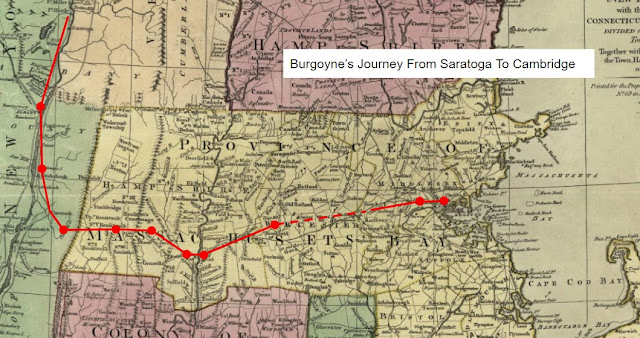
On December 17, 1775, Knox wrote to Washington from Fort George, at the south end of the lake: "... the rout will be from here to Kinderhook, from thence into Great Barrington, Massachusetts Bay & down to Springfield...". [2] In late December Knox traveled from Saratoga to Albany, and then on across Massachusetts in January of 1776. He and his men followed much of the same route British Lieutenant General John Burgoyne would take after his surrender at Saratoga in 1777, and the German column of the Convention Army after reaching Greenbush, New York.


On January 4, 1776, Knox noted in his diary: "arriv'd [in Albany] a brass 24 pounder & a small mortar". Whatever sense of accomplishment this brought him was likely short-lived. Although Knox had directed his men to cut holes in the ice on the Mohawk River (seen here at Cohoes Falls) in order for water to flow onto its surface and freeze to thicken it, "... [that] afternoon much alarm'd by hearing that one of the heaviest Cannon had fallen in to the river a At half moon ferry". [5]
The following day Knox sent Washington an update to his December 17, 1775, letter written at Fort George. In his letter he recounted that "... I then was in hopes that we should have been able to have had the Cannon at Cambridge by this time...". Now he had to explain: "... the want of Snow detain’d us some days & now a cruel thaw, hinders from Crossing Hudsons River which we are oblig’d to do four times from Lake George to this Town". Still optimistic, Knox hoped that instead: "In eight or nine days after the first severe frost they will be at Springfield from which place we can get them easily transported [the remainder of the way]". [6]
On January 6, 1776, disaster struck again. "The Cannon which the night before last came over at Sloss's ferry we attempted to get Over the ferry here, which we effected excepting the last which fell into the River notwithstanding the precautions we took, & in its fall broke All the Ice for 14 feet around It -- this was a misfortune as It retarded the dispatch which I wish'd to use in this business we push'd the 10 Sleds on which got over safe & then I went to getting the drown'd Cannon out which we partly effected tho but by reason of the nights coming cou'd not do it entirely." This time though, Knox shared that a day later, "... [we] were so lucky as to Get the Cannon out of the River, owing to the assistances the good people of the City of Albany gave In return for which we christen'd her the The Albany". On January 9th Knox said goodbye to General Schuyler, left Albany around noon, passed through Kinderhook and made it as far as Claverack. [7]
The following day Knox reached Tyringham, Massachusetts, which he referred to as "No. 1". Along the way he noted, they "Climb'd mountains from which we might almost have seen all the Kingdoms of the Earth". [8] A history of the town of Great Barrington includes a story about the artillery said to have been captured at Saratoga. I suspect though that it may be tied to Knox's train of artillery passing through in 1776. Allegedly: "Not long after the arrival here of the British [sic] prisoners of war, the fine train of artillery captured at Saratoga was drawn through the village. The people assembled and the children came out from school to witness the novel exhibition; and one old lady - the late venerable Mrs. Mary Pynchon - then a child - who was present, informed the writer that in the train was one cannon (probably a mortar) of enormous size drawn by several yoke of oxen; so large that some of the children crawled into it.” [9]
A gun with a bore large enough for children to crawl into would likely be a thirteen-inch mortar, but the British guns surrendered on October 17, 1777, were cannons and howitzers. Burgoyne started his campaign with two thirteen-inch mortars, but he put them on board the Royal George, one of the ships in the British fleet on Lake Champlain. [10] If no mortars were captured at Saratoga, perhaps Mrs. Pynchon was remembering the three iron thirteen-inch mortars that went through Great Barrington which Henry Knox took with him from Ticonderoga. [11]
Hauling tons of artillery across the Berkshires in the middle of winter had its challenges. Knox noted these in his diary, writing on January 11: "... went 12 miles thro' the Green Woods to Blanford It appear'd to me almost a miracle that people with heavy loads should be able to get up & down such Hills as Are here with any thing of heavy loads..." He would also note the impact this had on his men, when, "... at Blanford we overtook the first division who had tarried here until we came up -- and refus'd going any further On accott that there were no snow beyond five or six miles further in which space there was the tremendous Glasgow or Westfield mountain to go down -- but after about three hours perseverance & hiring two teams of oxen -- they agreed to go". [12]
Knox's diary ends with a reference to Westfield, still west of the Connecticut River, and nearly one hundred miles away from Cambridge: "Blanford Jany. 13. 1776 -- Recd of Henry Knox eighteen shillings Lawful money for Carrying a Cannon weighing 24.3 p from this Town to Westfield being 11 Miles -- Solomon Brown". [13] There, according to Becker's account, Knox or his men fired off one of the pieces of artillery they were hauling for townspeople to see. "We then reached Westfield, Massachusetts, and were much amused with what seemed the quaintness and honest simplicity of the people. Our armament here was a great curiosity. We found that very few, even among the oldest inhabitants, had ever seen a cannon. They were never tired of examining our desperate "big shooting irons," and guessing how many tons they weighed; others of the scientific order, were measuring the dimensions of their muzzles, and the circumference at the breach. ... One old mortar, well known during the revolution, as the old sow, and which not many years since, was the subject of eulogy on the floor of our own Legislature, by no less a personage than Gen. Root, was actually fired several times by the people of Westfield, for the novel pleasure of listening to its deep toned thunders." [14]The abrupt end of Knox's diary in Blandford, and Becker's return to New York from Springfield, leaves historians with their own problem to solve. Where did Knox and his train of artillery go after they crossed the Connecticut River, and when did they get there. These are questions of particular interest to those of us who live in towns along the route he likely took on the rest of his journey - but can they be answered?
1777 March Blog Home Overnight Stopping Points Towns and Villages Along the Way
General Whipple's Journal Burgoyne in Albany Annotated Bibliography
[2] https://founders.archives.gov/documents/Washington/03-02-02-0521-0001


Comments
Post a Comment