Major General Horatio Gates victory at the Battle of Bemis Heights, and the British surrender at Saratoga, New York, on October 17, 1777, together resulted in the capture and surrender of thirty-five pieces of artillery. These guns, cannons and howitzers, were likely sent south to Albany initially, to be used in the fight to secure American independence. [1]
It wasn't the first time captured British artillery moved south through Saratoga, and on to Albany. In late December of 1775, newly commissioned artillery officer Colonel Henry Knox had passed through, on his way to Cambridge, Massachusetts, followed soon after by teamsters hauling thirty-nine cannon, fourteen mortars, and two howitzers. These artillery pieces, along with a barrel of gun flints and over a ton of lead, most taken at Fort Ticonderoga and Crown Point in the first few weeks of the war, were bound for the Continental Army under General George Washington, which surrounded British occupied Boston. [2]
The modern sculpture seen here, at the corner of Stark's Knob Road and Route 4, just north of
Schuylerville, and a marker erected a century ago, pictured below, commemorate their passing. The Lake George, Fort Edward, Saratoga, and Albany areas will commemorate the 250th anniversary of Knox's epic journey the weekend of December 12th through the 14th, 2025.
On Saturday reenactors will mark the passage of the column through Washington County to Saratoga County with a parade in Fort Edward, a crossing ceremony at the Dix Bridge in the Hudson River Crossing Park, and "Knox Fest" in the afternoon at Fort Hardy Park, before moving on Sunday to Waterford, and then Albany. Most events are free, and open to the public. For more information, see the Saratoga 250th events website at:
Celebrating the 250th Anniversary of The Battles of Saratoga.
In December of 1775, no one knew if Knox would successfully deliver what he came to call his "Noble train of Artillery" to Washington. Knox first arrived at Fort George on December 4, 1775. The following day he wrote a letter to Washington stating: "The Garriso[n] at Ticonderoga is so weak, The conveyance from the fort to the landing is so difficult the passage accross the lake so precarious that I am afraid it will be ten days at least before I can get them on this side—when they are here—the conveyance from hence will depend entirely on the sleding—if that is good they shall immedia[tel]y move forward—without sleding the roads are so much gullied that it will be impossible to move a Step." [3]
Most of what we know about what followed comes from the journal Knox kept, which is now in the collection of the Massachusetts Historical Society, and available online on their website. One cannon was nearly lost crossing Lake George. At Fort George, on the south end of the lake, Knox struggled to make arrangements for men, sleds and draft animals to move the guns. [4]
Knox wrote to Washington from Fort George again on December 17, telling him:
"I have made forty two exceeding strong sleds & have provided eighty yoke of Oxen to drag them as far as Springfield where I shall get fresh Cattle to carry them to Camp. The rout will be from here to Kinderhook, from thence into Great Barrington, Massachusetts Bay & down to Springfield—There will Scarcely be any possibility of conveying them from here to Albany or Kinderhook but on Sleds the roads being very much gullied—At present the sledding is tolerable to Saratoga about 26 Miles; beyond that there is none—I have sent for the Sleds & teams to come up & expect to begin to move them to Saratoga on Wednesday or Thursday next trusting that between this & that period we shall have a fine fall of Snow which will enable us to proceed further & make the Carriage easy—if that should be the case I hope in 16 or 17 days to be able to present to your Excellency a Noble train of Artillery..." [5]
It's not clear when the sleds hauling Knox's artillery passed through Schuylerville. Knox left Fort George for Albany before the column. After a gap in his entries, likely due to one or more pages being lost, his journal notes that on the way there (likely on December 25):
"...we got with Considerable Difficulty to Arch McNeals Saratoga where we din'd & sat off about three oClock it still snowing exceeding fast & it being very deep after the utmost efforts of the horses we reach'd Ensigns 26 [???] about 8 Miles beyond saratoga where we lodg'd". The following day, two feet of new snow prevented him from traveling
"... farther than New City [Lansingburgh] about 9 miles above albany -- where we lodg'd". On December 27 he reached Albany and "
waited on Genl. [Philip] Schuyler & spent the evening with him". On December 28 Knox learned that the recently fallen snow was
"too deep for the Cannon to set out even if the Sleds were ready". Clearly it would take more time than he projected in his letter to Washington from Fort George to reach Cambridge and the Continental Army. [6]
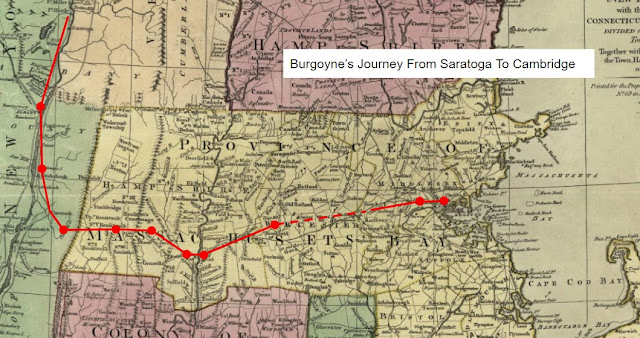
For more on the Convention Army's 1777 march from Saratoga to Boston, see:
1777 March Blog Home Overnight Stopping Points Towns and Villages Along the Way
General Whipple's Journal Burgoyne in Albany Annotated Bibliography
[1] On November 2, 1777, Gates wrote to New York Governor George Clinton from Albany:
“The heavy Brass Artillery I sent down the River should be sent up again by Water, or so disposed as to be secured from any surprize. The light Brass Field Guns, which you mentioned in a former Letter, should be sent with the Troops to Morris-Town." It's not clear to me whether Gates is referring to cannons which were captured at Saratoga, or American guns with the Northern Army. (See Footnote 1 at
https://founders.archives.gov/documents/Washington/03-12-02-0083.)
[2] Henry Knox to George Washington, December 17, 1775, Enclosure: Inventory of Artillery at Founders Online, National Archives https://founders.archives.gov/documents/Washington/03-02-02-0521-0002
[3] https://founders.archives.gov/documents/Washington/03-02-02-0446-0001.



Comments
Post a Comment