Posts

Showing posts with the label Whipple

Signer, Negotiator, Escort - "At My Request Appointed Brigadier-General Whipple"

Image
Why did Major General Horatio Gates choose Brigadier General William Whipple as one of his two delegates to negotiate the surrender at Saratoga, and to escort Lieutenant General John Burgoyne to Cambridge? Lieutenant Colonel James Wilkinson, Gates adjutant, claimed credit for the first of these decisions.  Wilkinson wrote in his memoir that on October 15, 1777, when Burgoyne proposed two officers from each side meet: "... General [Gates] was pleased to name me as one of his representatives, and at my request appointed Brigadier-general Whipple of the militia, to accompany me..." [1]  The key to John Trumbull's painting of the surrender, shown here, identifies all three: Gates, figure 14, at its center; Wilkinson, figure 13, to the left of Gates far back in the distance; and Whipple, figure 25, in profile looking left with his left forearm on the far wheel of the cannon. Gates selection of Wilkinson as one of his two negotiators makes sense.  Wilkinson served as a voluntee...

Saratoga Connections To The Declaration Of Independence - "We Arrived In The Evening"

Image
Half a century ago, as the United States prepared to celebrate its two hundredth birthday, New York historian Paul Scudiere began the introduction to his biography of New York's signers of the Declaration of Independence with the statement: "The most important single event in the history of the American nation was the adoption of the Declaration of Independence by the Continental Congress on July 4, 1776."  He went on to point out: "Although New York played a key role in the winning of independence and in the establishment of American democratic government, the New York delegates then in Congress did not vote on Richard Henry Lee's resolution 'that these United Colonies are and of right ought to be, free and independent states,' on July 2, 1776, nor on the Declaration itself when it was considered two days later." [1] Historians tell us the Declaration of Independence was not signed on July 4, and the process of signing didn't look anything like ...

Nobletown Or Hillsdale - "Seventeen Miles To A Miserable Village"

Image
The German column of the Convention Army marched seventeen miles on October 24, 1777, then stopped for the night near  "... a miserable village."   It would be their last night in New York (in 1777 at least), or perhaps their first night in Massachusetts.  Their march  "on hilly and stony roads"  had taken them well into the Taconic Mountains, and to  "... Nobletown, a village undeserving of its beautiful name."  [1]  Their stay was not pleasant, as:  "... we had to sleep in the open air for want of houses; we got so covered with frost during the night that we looked like great sugar dolls."  [2]   The Germans were not the first or the last Revolutionary War travelers to stop in the village.  Impressions were mixed.   Several months earlier Lieutenant Samuel Armstrong of the 8th Massachusetts Regiment of the Continental Line had passed through.  On July 21st he noted that he: "... march'd 8 miles to Kenyon's...

General Burgoyne Continued - "Attended Mr. Burgoyne To Boston"

Image
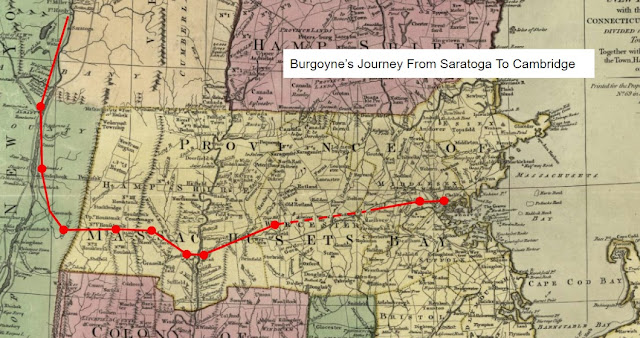
Last week I shared that tracking the 1777 journey of Lieutenant-General John Burgoyne from Saratoga to Cambridge was a challenge.  Several primary sources document he stayed in Albany at Major-General Philip Schuyler's home until October 27th, and arrived in Cambridge on November 7th.  Less clear was where he stopped in between, though multiple locations lay claim to the statement "Burgoyne slept here" - some relatively easy to challenge, others not so much so. Travelers during the Revolutionary War going from Albany to Boston (or Boston to Albany) generally followed one of two major routes that correspond to the routes taken by the British and German columns.  A traveler leaving Albany could head south towards Kinderhook, then east through Great Barrington to Springfield, and on to Boston (or Cambridge for our purposes) along the Western Post Road.  Alternatively, a traveler could head east from Albany to Pittsfield or Williamstown, then through the Berkshires to c...