"July 14 [1776] set out from Crown Point..." Continental Army Lieutenant Benjamin Whitcomb wrote in his after-action report three weeks later, "... went seven miles that night." After describing the challenges he faced traveling one hundred miles north from the Northern Army's position in New York into British controlled Canada, on July 20 he continued: "In the evening we came within about five miles of St. John's, heard the drum beat, etc.". There, on the east bank of the Richelieu River, as two of the others traveling with him were "uneasy and not willing to go near St. John's, I told them to take a Frenchman and examine him and return home". [1. Whitcomb's full report is in the footnotes, below.]

The next day he and his remaining companion "...lay there all day in hopes of taking a prisoner, but none appeared." On July 22, "... at day-break, we went down to the river side, staid there till the sun was half an hour high, counted thirty batteaus in the water all finished, nine on the stocks... finding none except the guard, they keeping close, we imagined it difficult to get a prisoner there. We then set out to go to Chambly...". After crossing over to the west bank of the river and continuing to observe the enemy, the two of them "... supposed there were at St. John’s, of Regulars, between two and three thousand. ... That evening [I] went in search of provisions, at which time the man who was in company left me." (Image shows “A South West View of St. John’s, Quebec,” by James Hunter, circa 1779:
Library and Archives Canada, Acc. No. 1989-221-6.)
For two more days Whitcomb watched and waited, alone, until on July 24: "... about twelve o'clock, then fired on an officer... ". Twelve days later, after evading capture by hiding in the woods and avoiding "... a party of Regulars coming towards me... twenty-seven armed Indians... [being] detained by bad weather, and under great disadvantages in travelling for want of a compass.", he concluded his report with the statement: "Arrived at this place [Ticonderoga] on the 6th of August. Benjamin Whitcomb, Lieutenant.”
His return to Fort Ticonderoga, in New York, was noted in the diaries of several officers stationed there. Colonel Elisha Porter from Massachusetts wrote on August 6: “Lt. Whitcomb arrived from a scout as far as Chambler [sic]. One man of my Regt. that was with him deserted at St. Johns. He says there were between 2 and 3000 at St. Johns, and also a Regt. at Chambler. They had 30 Batteaux in the water, and 9 on ye stocks - nothing larger.” [2] Colonel Jeduthan Baldwin likewise noted that same day: “this Day Lieut. Whicomb returnd. from a Scout, has been near St. Johns, but brings no acct. Of our Flag, or of Capt. Willsons party, & that there is to appearance near 2000 Regulars at St. Johns…” [3]
Baldwin's reference to "Capt. Willsons party" highlights the extensive nature of American efforts to obtain information on enemy activity, and the danger Whitcomb and others faced in doing that. British Lieutenant Willim Digby with the 53rd Regiment of Foot in Canada noted in his diary not only what happened to Wilson, but what the British were doing to deal with the American threat, writing on July 2: "Lieut Frazier 9 regt and lieut Scott 24 regt were sent on a party of observation by gen Frazier to discover if possible what the enemy were about on the lake. ... About 20 miles from St John's near the Isle aux Noix - island of nuts - they fell in with a party of the enemy, and, after some fireing, brought them to us prisoners, with the loss only of one Indian and a few wounded. The captains name was Wilson, who informed us they were very strong at Crown Point and Ticonderoga..." [4]
Forty years later, James Wilkinson, who served as an aide to Brigadier General Benedict Arnold until July 17 and then a brigade major before he became an aide to Major General Horatio Gates, recalled the conversation he had with Whitcomb in his memoir, writing: “Lieutenant Whitcomb, of Warner's regiment [sic], an unlettered child of the woods from the frontier of the Hampshire grants, with all the little stratagems of an Indian, and a dauntless heart, had been selected for the service, and sent into Canada before General Gates's arrival, to take a prisoner, for the purpose of intelligence."
Wilkinson related that after Whitcomb found himself alone on July 22, he narrowly escaped capture on several occasions. Whitcomb apparently shared several details in his conversation with Wilkinson that did not appear in his report. By Wilkinson's account, on July 24 Whitcomb "... then ambuscaded the road leading from Chamblee to St. John's, at a point from whence his eye commanded an extensive view up and down." There, when a solitary officer chanced to pass on horseback "within thirty feet of Whitcomb's ambuscade; he presented, took aim, covered his object, and kept his sight on him until he got a side view of his back; he then fired, and the ball took effect under the right shoulder blade, but the wound, though mortal, did not produce sudden death..." [5]
The information which Whitcomb returned with was deemed to be credible. Two days after Whitcomb's return, Arnold wrote to Major General Philip Schuyler: “General Gates transmitted you last week the testimony of two French Captains, lately from Canada, which is contradicted by a Lieutenant B. Whitcomb, who was lately sent from Crown-Point to St. John's, which place he left the 31st ultimo. He went down on the east side, as far as Chambly, and returned on the west. Says he observed about forty batteaus at St. John's, and some others building, but no large vessels; believes there were about two thousand men there, and one thousand between St. John's and Chambly." [6] Samuel Adams, an ardent Patriot, wrote to his cousin John Adamson August 16: "Lt Whittemore [sic] returnd from his Discoveries. He left St. Johns July 30 saw 2000 or 2500 at that place and Chamblee. Stores coming on from Montreal. Counted 30 Batteaus. No Vessell built or building. This Account may I think be depended upon." [7]
Whitcomb's statement in his official report that on July 24 he "fired on an officer, and moved immediately into Chambly road" omits a key detail, one that explains the intensity of the British effort to locate him before he could return to Ticonderoga, and would lead to controversy on both sides. More to follow on that...
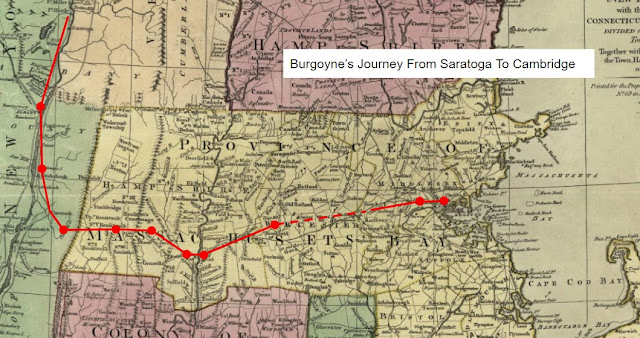
For more on the Convention Army's 1777 march from Saratoga to Boston, see:
[1] Peter Force, American Archives, 5th ser., 1:828–829. Whitcomb's full report reads as follows: "July 14th, set out from Crown-Point, went seven miles that night ; the wind being very high, we could go no farther. Fifteenth day we got to Onion River at dark; the wind and rain being severe, we could go no farther. Sixteenth day was obliged to lay by, the weather being very tempestuous. Seventeenth, in the evening, we set out, and went twenty miles. Eighteenth the wind and rain being so severe, we could not move from our present station. Nineteenth, at night, we set out and arrived at the head of Masisque-Bay at break of day. Twentieth day we travelled till we came opposite St. John's. The two Frenchmen being uneasy and not willing to go near St. John's, I told them to take a Frenchman and examine him and return home; upon which we left them, and went towards St. John's. In the evening we came within about five miles of St. John's, heard the drum beat, etc. Twenty-first, the day being cloudy and rainy, we got to the river about noon; we lay there all day in hopes of taking a prisoner, but none appeared. Twentysecond, at day-break, we went down to the river side, staid there till the sun was half an hour high, counted thirty batteaus in the water all finished, nine on the stocks; there were also six saws employed by hand to saw boards, all appearing to work with great life and activity; staying there all day till night, and finding none except the guard, they keeping close, we imagined it difficult to get a prisoner there. We then set out to go to Chambly, and on the way saw four batteaus laden with barrels; we then proceeded to a French house, where we found a canoe, and crossed the river at the lower end of the Island, where we saw a large number of lights, and supposed them to be a party of Regulars consisting of about one hundred. We supposed there were at St. John’s, of Regulars, between two and three thousand. Then going into the road leading into Montreal, we soon perceived we were discovered by the enemy; returned from the road a small distance, and then went forward about a mile and came into the road again. Immediately a file of men passed, upon which I concealed myself, and after they had passed me, returned again into the road and followed them a small distance, where I perceived them sitting, who discovered us again, upon which we concealed ourselves a second time. Coming again near the road, we made observations on the road and passengers; observed seventeen carts laden with barrels going towards St. John's ; also seven armed Indians. That evening went in search of provisions, at which time the man who was in company left me. Twentythird, early in the morning, I returned to my former place of abode, staid there the whole day, saw twenty-three carts laden with barrels and tents going to St. John's. Twentyfourth, staid at the same place till about twelve o'clock, then fired on an officer, and moved immediately into Chambly road; being discovered, retreated back into the woods, and staid till night; then taking the road and passing the guards till I came below Chambly, finding myself discovered, was obliged to conceal myself in the brush till dark. The 25th instant, on which I made my escape by the guards, I saw upwards of forty carts preparing to go to St. John's, and I judge there were lying at that place and on the road about one full regiment of Regulars. Twenty-sixth, on my march towards Montreal road, I saw a party of Regulars coming towards me, upon which I made my escape as fast as possible, by the way promising myself some provisions. Came to the aforesaid road again; saw twenty-seven armed Indians passing towards St. John's, and a considerable number of empty carts returning towards Montreal; at the same time heard thirty-four platoons fired towards Montreal, and heard near the same number fired every evening and morning from the same parts during the whole of my stay in those parts. Twenty-seventh, setting out for home, on the west side of the Lake, nothing remarkable happened, only detained by bad weather, and under great disadvantages in travelling for want of a compass. Arrived at this place on the 6th of August. Benjamin Whitcomb, Lieutenant.”
[2] Diary of Elisha Porter, Magazine of American History, Vol. 30, No. 3, Sept. 1893, 204.
[3] Jeduthan Baldwin, The Revolutionary Journal of Colonel Jeduthan Baldwin 1775-1778 (North Stratford, NH: Ayer Company, 2001), 65.
[4] William Digby, The British Invasion From The North... With The Journal of Lieut. William Digby of the 53rd, or Shropshire Regiment of Foot, 122-126. A footnote indicates Wilson was Captain James Wilson of the Sixth Pennsylvania Regiment. Wilkinson claimed in his memoir that Wilson was captured by Captain James Craig of the 47th Regiment of Foot, one of Burgoyne's negotiators when he surrendered at Saratoga. [Wilkinson, 1:67.]
[5] James Wilkinson, Memoirs of My Own Times (Abraham Small, 1816), 1:67-70.
[6] Benedict Arnold to Philip Schuyler, August 8, 1776, Force, American Archives, 5th Series, 1:1033.
[7] Samuel Adams to John Adams, August 16, 1776, New York City. Collection of the Massachusetts Historical Society:
https://masshist.org/publications/adams-papers/index.php/view/ADMS-06-04-02-0214. Samuel Adams, reported to be in bad health, left Philadelphia on August 12 to return home and rest. He was traveling with William Whipple, a fellow delegate delegate to the Continental Congress, who would escort Burgoyne from Albany, New York, to Cambridge, Massachusetts, after he surrendered at Saratoga in October of 1777. [Footnote 1,
https://www.masshist.org/publications/adams-papers/index.php/view/PJA04d265#PJA04d265n1.]



Comments
Post a Comment