Posts

Claverack, New York - "Blessing For Our Journey"

Image
The German column of the Convention Army spent two nights in   Kinderhook, New York , and  resumed their march from Saratoga to Cambridge on October 24, 1777 .   T heir commander,  Major-General Friedrich Adolph Riedesel , along with his wife and three of their children, now traveled with them.  In the week since the surrender on the 17th, the column had traveled south through the Hudson River Valley and now southeast along the west slope of the  Taconic Mountains .  Four months earlier Johann Christoph Dehn, a clerk with the Specht regiment, had written optimistically to his parents in Germany: "We are on a march to visit the rebels. To this end, we will be embarking on Lake Champlain, leave Canada and take up residence in Albany."   [1]  Instead, their march on the 24th would take them further east and further away from the objective of their campaign. From Kinderhook they entered Claverack.  "Klaverack", as it appears o...

What The Convention Army Ate - "They Will Want About 400 Barrels Of Flour"

Image
When the British Army surrendered at Saratoga on October 17, 1777, Lieutenant-General John Burgoyne's soldiers were close to starving.    Brigadier-General William Whipple "who with Gen. Glover conducted G. Burgoyne & his Army prisoners from Saratoga to Cambridge..."  shared with the Reverend Ezra Stiles that Massachusetts Militia  troops had c aptured three-quarters of the supplies Burgoyne had left, and at the time of surrender "... Burgoyns Army had but one day's Store of Bread left & this bad ... & the failure of Stores obliged him to surrender on the 17th."   [1 ]   Article V of the  Articles of Convention  shifted the responsibility for feeding Burgoyne's men to his American captors, providing:  "The troops are to be supplied on their march ... with provisions, by General Gates's orders, at the same rate of rations as the troops of his own army...".   Neither British or American soldiers ate well by today's ...

What The Convention Army Saw - "To Delight The Eye"

Image
The prisoners of the Convention Army traveled through a region most had likely heard about, but never seen.  Their march from the Saratoga battlefield in the fall of 1777 took them through Hudson Valley villages settled by Dutch and German farmers, isolated hamlets in the Berkshires which had sprung up beyond prosperous English settlements along the Connecticut River, and the towns of Worcester and Middlesex Counties which marked a century and a half of expansion from the settlement of Boston in 1630; all land occupied by a Native population for countless generations before the arrival of Europeans.   What did they see?  Most obvious was the terrain: two major rivers and two mountain ranges before reaching the hills of central Massachusetts, and then their barracks overlooking Boston Harbor.   A painting in the collection of the Worcester Art Museum, " Looking East From Denny Hill"  seen in an image © Worcester Art Museum , offers a glim...

Sorry Hadley - "He [Never] Left Behind His Sword"

Image
The first town on the route of march of the British column after crossing to the east bank of the Connecticut River was Hadley, Massachusetts.  Many of the British prisoners spent the nights of October 27th and 28th in Northampton, waiting for the weather to clear, and passed through or stopped in Hadley on the 29th.  Others crossed over the river, arrived in the town October 31st, and spent the night.   Most of those who kept journals of the march paid little attention to the town.  Massachusetts Militia Lieutenant Israel Bartlett would note: “[Oct.] 29 Wednsday. We are ordered to advance in front.  We marched [from Northampton] and crossed the river at 10 o’clock, and advanced four miles from Hadley: place called Amherst.”   Others, including Private David How stopped there: “[Oct.] 29 This Day we Crossed Coniticut River [from Northampton] and Staid at old Hadley At Night  Its ben Wet marching”   Most British entries were even briefer: "Oct...

Sorry Northampton (and Smith College) - "[Not] The Site Of Clandestine Visits"

Image
There is no question that the British element of the Convention Army stopped in Northampton, Massachusetts, in October of 1777.  Lieutenant Israel Bartlett , one of their assigned guards from the Massachusetts Militia, recorded in his diary: "[October] 27 Monday.  We marched to Northampton today, 18 miles, through the rain & mud, very fatiguing.  Arrived at 2 O'Clock..." [1]  Militia Private David How noted the same: "This Day Its ben Very wet and rainy And we march'd to North Hampton And Staid at Night thare."  [2]   The column rested a day in Northampton before crossing the Connecticut River.  Bartlett and How writing respectively:  "[October] 28 Tuesday.  We rested at Hampton [Northampton] all day on account of a very severe storm of rain and snow." and "[October] 28 This Day It has Ben Very Stormy both Hail & Snow and we Staid Hear all Day and Night." [3] British prisoners noted likewise.  Lieutenant (Lord) Francis Nap...

The Surrender Celebrated - "Freedom To The Whole World"

Image
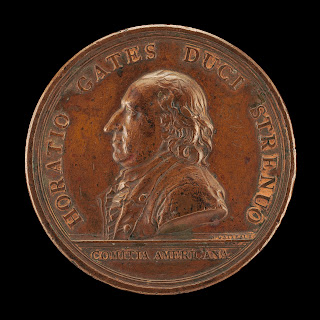
News of British Lieutenant-General John Burgoyne's surrender to Major-General Horatio Gates at Saratoga, New York, on October 17, 1777,  spread quickly .  Patriotic citizens of the young United States of America were jubilant, and celebrated in a number of ways.   Those present at the surrender noted their feelings in their journals and diaries, and the letters they sent home.  For Doctor Samuel Merrick of Massachusetts, who had seen firsthand the suffering of the troops who retreated south from Canada in 1776, it was "A day never to be forgotten by the American States. ... The Lord be praised for this wonderful token of divine favor for which we cannot be sufficiently thankfull." [1]  Colonel Ralph Cross of the Massachusetts Militia described what he saw as "... a Grand Sight as ever was Beheld by Eye of man in America."  [2]  In the habit of the times, men gathered in local taverns to toast the victory, and local newspapers reported those...

Preparing For The Surrender - "As Any Of The Most Polished Nations"

Image
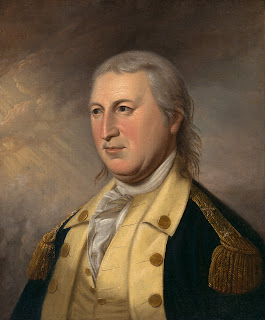
Tuesday, October 17th, is the 246th anniversary of the British surrender at Saratoga.  On that day in 1777, Major-General Horatio Gates, commander of the Northern Army of the United States, ordered his soldiers to be prepared.   “The regiment of riflemen under the command of Colonel Morgan and the company of Light Infantry under the command of Major Dearborn to be ready when ordered to take possession of the enemy’s lines, posts, and redoubts. The commanding officers of those troops are to be particularly attentive to the soldierlike and good behavior of their men. The enemies of the United States have propagated an opinion among the British and German troops that the Americans are barbarians who pay no regard to the faith of treaties, and whose sole view is rapine and plunder. From the preceding glorious behavior of the army, the General is convinced that not an officer or soldier under his command will suffer the smallest infringement of the convention. Their general ha...

Kinderhook Part II - "October 23d Cost Us Some Good Men"

Image
On October 22, 1777,  "... after plodding fifteen miles..." from Greenbush , the German column of the Convention Army reached the town of Kinderhook, New York. [ 1]  The name, meaning "children's corner" in Dutch, may have been given to the area in the early 1600's by Dutch explorers who saw Native children on a river bluff watch them sail past - or maybe by Dutch traders, as a Swedish settler with numerous children lived there.  What makes up the town today is set on the Kinderhook Creek, seven miles northwest of the Hudson River, and twenty miles southeast of Albany, though the town's boundaries initially extended all the way to the river.   Kinderhook's first European residents were Dutch and Swedish settlers who arrived around 1650. [2]  The Dutch exploration and settlement of the Hudson River valley was more apparent to the Convention Army, in towns as far north as Stillwater, New York , and as east as Pownal, Vermont , than it is to many of us ...