Posts

Showing posts with the label Connecticut River

The Germans At The Connecticut River - "So That In The Morning Nothing Will Interfere With The Crossing"

Image
There was no bridge across the Connecticut River at  West Springfield, Massachusetts , in 1777.  This meant that the men, women, children, horses and baggage wagons which made up the German element of the Convention Army, and their guards, would all cross by ferry, as  the   British column was doing at Northampton .  Such a crossing required organization as well as resources.   German accounts provide us some insight on how they accomplished the task, starting on October 29, 1777.      The Germans began the process by issuing orders prior to crossing directing all unit commanders to ensure that  "Necessary watch for each regiment, and necessary helmsmen were [assigned] so that in the morning nothing will interfere with the crossing." [1]   Some of the guards escorting the Germans were the first to cross, as was the case with the British column.  Private Joshua Pillsbury of the Massachusetts militia wou...

The British At The Connecticut River - "Crossed The River At 10 O'Clock"

Image
On October 29, 1777, the British Column of the Convention Army faced the last remaining major natural obstacle on their march to Cambridge, Massachusetts.  The day after their surrender at Saratoga they had crossed the Hudson River .  In the tens days that followed they had marched through a corner of Vermont , south to Pittsfield, Massachusetts , and then east to  Northampton,  on the west bank of the Connecticut River. Rivers were a formidable obstacle to travelers in the eighteenth century, especially an army numbering in the thousands which included soldiers (and some of their wives and children) marching on foot, officers on horseback, and horse or ox-drawn wagons loaded with personal belongings, equipment and supplies.  There was no bridge from Northampton to Hadley, or anywhere else along the Connecticut River in 1777.  The first was not completed until 1785, fifty miles upstream, between Walpole, New Hampshire, and Bellows Falls, Vermont. [1] Crossi...

What The Convention Army Saw - "To Delight The Eye"

Image
The prisoners of the Convention Army traveled through a region most had likely heard about, but never seen.  Their march from the Saratoga battlefield in the fall of 1777 took them through Hudson Valley villages settled by Dutch and German farmers, isolated hamlets in the Berkshires which had sprung up beyond prosperous English settlements along the Connecticut River, and the towns of Worcester and Middlesex Counties which marked a century and a half of expansion from the settlement of Boston in 1630; all land occupied by a Native population for countless generations before the arrival of Europeans.   What did they see?  Most obvious was the terrain: two major rivers and two mountain ranges before reaching the hills of central Massachusetts, and then their barracks overlooking Boston Harbor.   A painting in the collection of the Worcester Art Museum, " Looking East From Denny Hill"  seen in an image © Worcester Art Museum , offers a glim...

General Burgoyne Continued - "Attended Mr. Burgoyne To Boston"

Image
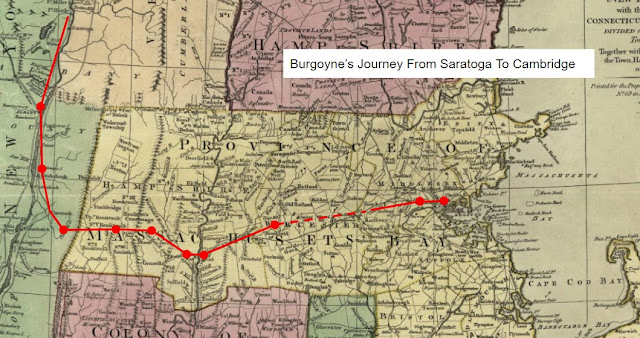
Last week I shared that tracking the 1777 journey of Lieutenant-General John Burgoyne from Saratoga to Cambridge was a challenge.  Several primary sources document he stayed in Albany at Major-General Philip Schuyler's home until October 27th, and arrived in Cambridge on November 7th.  Less clear was where he stopped in between, though multiple locations lay claim to the statement "Burgoyne slept here" - some relatively easy to challenge, others not so much so. Travelers during the Revolutionary War going from Albany to Boston (or Boston to Albany) generally followed one of two major routes that correspond to the routes taken by the British and German columns.  A traveler leaving Albany could head south towards Kinderhook, then east through Great Barrington to Springfield, and on to Boston (or Cambridge for our purposes) along the Western Post Road.  Alternatively, a traveler could head east from Albany to Pittsfield or Williamstown, then through the Berkshires to c...

Saratoga to Boston 1777 - "The Easiest, Most Expeditious, and Convenient Route"

Image
Article IV of the Articles of Convention required "The army under Lieutenant-general Burgoyne, to march to Massachusetts Bay, by the easiest, most expeditious, and convenient route; and be quartered in, near, or as convenient as possible to Boston..." Understanding the routes taken is a study of history and geography.  There is no direct natural route from Saratoga to Boston, but a well established network of roads provided a way across rivers and streams, over mountains, through woods, and past countless farms and villages.  American militia units had taken many of these roads in the summer and early fall of 1777 to join the Northern Army under Major-General Horatio Gates at Saratoga, and would use them to escort Lieutenant-General John Burgoyne's British and German troops to quarters in Cambridge and present-day Somerville (then part of Charlestown) Massachusetts to await their fate.  I'm interested in following their footsteps as closely as possible. Two accounts ...