Posts

Surrender At Saratoga - "The Greatest Conquest Ever Known"

Image
For some time I assumed Lieutenant-General John Burgoyne's Saratoga Campaign came to an end in mid-October of 1777, when his army had advanced south as far as it was able, only to be stopped in its tracks and forced to surrender.  When I started exploring the route of the Convention Army, I assumed that the  Surrender Site  would be where British and German troops had laid down their arms.  Now, after some additional research, and a weekend visit to  Saratoga National Historical Park , I've learned those assumptions were wrong - and another visit to Schuylerville is in order, as there is more to see there than I'd realized. The story of Burgoyne's surrender at Saratoga is linked to a a number of locations.  One would be what is now called  "Victory Woods" , a misleading name from the British perspective perhaps, that reflects its location in the present-day  Village of Victory , incorporated in 1849, rather than any description of the site in 1777...

Saratoga to Boston 1777 - "The Easiest, Most Expeditious, and Convenient Route"

Image
Article IV of the Articles of Convention required "The army under Lieutenant-general Burgoyne, to march to Massachusetts Bay, by the easiest, most expeditious, and convenient route; and be quartered in, near, or as convenient as possible to Boston..." Understanding the routes taken is a study of history and geography.  There is no direct natural route from Saratoga to Boston, but a well established network of roads provided a way across rivers and streams, over mountains, through woods, and past countless farms and villages.  American militia units had taken many of these roads in the summer and early fall of 1777 to join the Northern Army under Major-General Horatio Gates at Saratoga, and would use them to escort Lieutenant-General John Burgoyne's British and German troops to quarters in Cambridge and present-day Somerville (then part of Charlestown) Massachusetts to await their fate.  I'm interested in following their footsteps as closely as possible. Two accounts ...

The Articles of Convention - "Mutually Signed and Exchanged"

Image
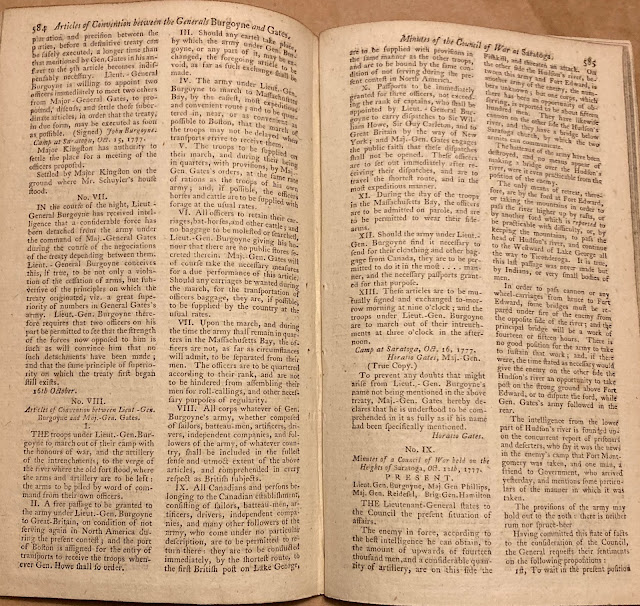
On October 14, 1777, Lieutenant-General John Burgoyne Burgoyne, commander of the British expedition to seize the Lake Champlain and Hudson River Valleys, sent a messenger to Major-General Horatio Gates, commander of the opposing American forces, to propose a cease-fire and negotiate an end to the fighting  "... to spare the lives of brave men upon honourable terms."   Gates replied that Burgoyne's men should surrender, lay down their arms, and march to New England by way of Bennington, Vermont as prisoners of war.  Burgoyne responded his men would sooner fight to the death than lay down their arms in their camp, and proposed instead that his army be given free passage to England on the condition that they not serve in North America again. [1]   Gates agreed in principle to Burgoyne's proposal on the 15th, adding that Burgoyne's troops should make ready to begin a march to Boston the following day.  Late on the night of the 15th another message reached ...

The Saratoga Campaign - "The Causes Of The Disaster"

Image
Lieutenant-General John Burgoyne launched his campaign to regain control of Lake Champlain and advance to Albany, New York, in June of 1777 with over 8,000 British, German, Canadian and Provincial troops, and Native allies.  On October 17, 1777, under the Articles of Convention  he accepted to end the fighting, his men laid down their arms in present-day Schuylerville, New York, and prepared to begin their march into captivity. Seven months after the defeat of his army, Burgoyne was in London "... to explain the causes of the disaster at Saratoga..." [1]   In this short summary of his campaign I am relying in a large part on Burgoyne's own words, published in London in 1780 as A State of the Expedition From Canada, As Laid Before The House Of Commons, By Lieutenant-General Burgoyne, And Verified By Evidence, With A Collection Of Authentic Documents...   Additional information has been drawn from the US Army Combat Studies Institute Press  Staff Ride Handboo...

The 1777 March of The Convention Army - "Two Hundred Miles From Saratoga To Boston"

Image
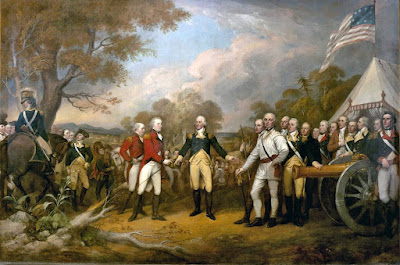
On October 18, 1777, over 6,000 men, women and children set out on a march from Stillwater, New York to Boston, Massachusetts - and never made it! These were the British and German troops of Lieutenant-General John Burgoyne, some accompanied by their wives and children, unsuccessful in their attempt to take control of the Lake Champlain and Hudson River Valleys.  Guarding them were citizen-soldiers from American militia units, who together with Continental Army forces under the command of Major-General Horatio Gates, stopped an invasion in its tracks, and in doing so changed the course of history. A day earlier Burgoyne had offered his sword to Gates in a gesture of surrender to the victorious  American army, as pictured in the painting "The Surrender of General Burgoyne" by artist and Revolutionary War veteran John Trumbull (accessed through the website of  The Architect of the Capitol ). Burgoyne's troops marched "... out of their camp with the honours of war, ......

A Bibliography Related to the People, Places and Events of the 1777 March of the Convention Army from Saratoga to Boston

Image
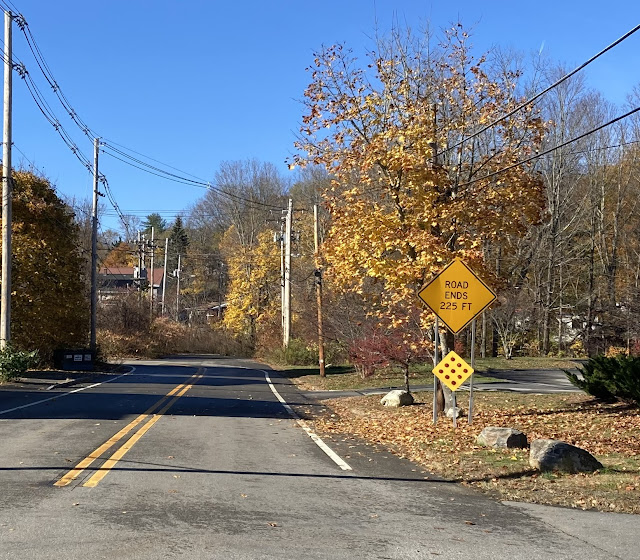
In October of 2022, I set out to explore the line of march of the Convention Army in 1777 from Saratoga, New York, to Cambridge, Massachusetts. I assumed the march was simple enough, a single route with nightly stops along the way.    I've read letters, diaries and journals written by some of the 6,000 men, women and children who marched as prisoners or guards, as well as the people they encountered; seen rivers, streams, mountains, buildings and other sights they saw; and met people along the way who love history and their community, and are happy to share their knowledge and passion. My knowledge of the march remains incomplete, but what I've learned has given me insight on the people of 1777, the places they went, and the sacrifices they made, regardless of their allegiance or status in life. My research, like my attempt to follow their path, has had its twists and turns, like the road in the photograph below that once passed over Kettle Brook in Leicester, Massachusetts....