British Brigadier General Patrick Gordon died on August 1, 1776, a week after he was shot near St. Johns, Quebec, by American Lieutenant Benjamin Whitcomb. Three days later Sir Guy Carleton, the commander in chief of British forces in Canada ordered: "The commanding Officers of Corps will take especial care that every one under their command be informed, that Letters, or messages from Rebels, Traitors in Arms against the King, Rioters, disturbers of the public Peace, Plunderers, Robbers, Assassins, or Murderers, are on no occasion to be admitted: That should emissaries from such lawless Men again presume to approach the Army, whether under the name of Flag of Truce Men or Ambassadors except when they come to implore the King's mercy, their persons shall be immediately seized and committed to close confinement to be proceeded against as the Law directs: Their Papers & Letters for whomsoever directed (even this Com'r in Chief) are to be deliver'd to the Provost Martial, that unread and unopen'd they may be burnt by the hands of the common Hangman." [1]

The American response was mixed. After its retreat from Canada, the Northern Army needed to know what the enemy was doing. On July 16, 1776, Gates had written to General George Washington from Ticonderoga that: "... Since the beginning of May, the Losses sustain’d by the Enemy, Death & Desertion, amounts to more than Five Thousand Men, and to this must be added, three Thousand that are now Sick. Our Accounts from the Enemy are lame, and imperfect; this seems not to be doubted, that they have a large Camp at St Johns, & are labouring to get a Naval Force upon the Lake. I shall do all in my power to procure the best Intelligence of their Motions. ..." [2]
Several senior officers,
Benedict Arnold among them, simply mentioned that Whitcomb had succeeded in bringing back information on British preparations in Canada. Lieutenant Colonel Matthew Ogden, with the 1st New Jersey Battalion at Fort Ticonderoga, learned of Carleton's order on August 10. The next day in a letter to Aaron Burr he both condemned and praised what Whitcomb had done, writing: "Last evening the flag of truce returned, bringing a letter directed to George Washington, Esq., and a truly ridiculous copy of a general order, which you will see at General Washington's by the time you receive this. But there is one part of it in which I think they in some measure accuse us justly: I mean that of assassinating, as they term it with too much truth, Brigadier-General Gordon. He was shot by the Whitcomb I mentioned in my last, who had been sent there as a spy. The act, though villanous, was brave, and a peculiar kind of bravery that I believe Whitcomb alone is possessed of. He shot Gordon near by their advanced sentinel; and, notwithstanding a most diligent search was made, he avoided them by mere dint of skulking." [3]
Lieutenant Colonel James Wilkinson, Major General Horatio Gates' adjutant, claimed Whitcomb disobeyed his orders in shooting Gordon. Wilkinson wrote in his memoir that he spoke with Whitcomb after he returned, noting that Whitcomb had been "... sent into Canada before General Gates's arrival, to take a prisoner, for the purpose of intelligence. Being well acquainted with his business, he chose one man only for death. ... The hard fortune of Brigadier-General Gordon of the British army, led him the same morning to take a solitary ride, and his approach was discovered by Whitcomb, soon after he had taken his stand."
Whitcomb's motivation, Wilkinson wrote, was "The General was in full uniform, his epaulets rich, he might have a gold watch and money about him, and he appeared to be a great chief. The time for our partisan's return was at hand, and it was uncertain whether he could make a prisoner, and if he did, being alone, it would be difficult to conduct him in. This reasoning was too powerful for Whitcomb's sense of morals and humanity; he determined to disobey his orders, and marked his victim."
Wilkinson claimed that while "... Whitcomb believed he was performing a meritorious act ... This abominable outrage on the customs of war and the laws of humanity, produced a sensation of strong disgust in the army, and men of sensibility and honour did not conceal their abhorrence of its perpetrator. Yet it was impossible, in the temper of the times, to bring him to punishment, without disaffecting the fighting men on that whole frontier. But if he could not be punished consistently with sound policy, yet his promotion to a majority the ensuing winter, not only sanctioned the murder but rewarded the murderer. — Such are the dreadful demoralizing effects of war, and more particularly of a civil war!!!" [4]
British Ensign Thomas Anburey, also writing after the war, noted: "When Whitcomb returned to Ticonderoga and informed the general who commanded there that although he could not take an officer prisoner he believed he had mortally wounded one the general expressed his disapprobation in the strongest terms and was so much displeased at the transaction that Whitcomb in order to effect a reconciliation offered his service to go again professing he would forfeit his life if he did not return with a prisoner." [5] Whitcomb was true to his word it turned out. In September he went into Canada again. This time he returned with a prisoner, Ensign Alexander Saunders of the 29th Regiment of Foot. Still, when word of his success was published in the Continental Journal on October 10, 1776, as pictured above, he was described as "Lieut. Whitcomb who killed Brig. Gen. Gordon near St. Johns". [6]
Word of the shooting reached Washington. On August 20 he wrote to Congress: “The assassination of Brigadier General Gordon is a fact entirely new to me, in which I never heard of. I shall not trouble congress with my Strictures on this indecent, illiberal, and Scurrilous performance, so highly unbecoming the character of a Soldier and Gentleman, only observeing that its design is somewhat Artful...”. [7] Apparently Congress thought of Whitcomb as brave and artful too, as on October 15 they voted "That two independent companies, consisting of fifty men each, be immediately raised, to be commanded by Lieutenant Whitcomb, who should be appointed captain commandant; that he nominate the officers of the said two companies, who are to be appointed when approved of by the commanding officer of the northern department." [8]
One year later Whitcomb would be among the twenty thousand or so American troops who surrounded Lieutenant General John Burgoyne and his army at Saratoga. Perhaps the allegation that Whitcomb was motivated by the hope for plunder when he shot Gordon was one of the factors which led Burgoyne and Gates to agree to terms which included a provision that allowed "All officers to retain their carriages... [and] no baggage to be molested or searched". [9]
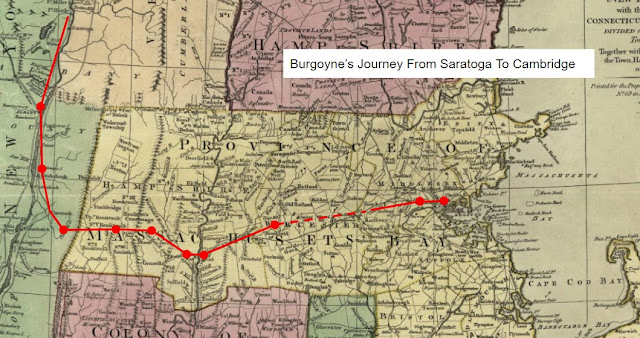
For more on the Convention Army's 1777 march from Saratoga to Boston, see:
[1] William Digby, James Phinney Baxter, ed., The British Invasion From The North... With The Journal of Lieut. William Digby of the 53rd, or Shropshire Regiment of Foot, (John Munsell's Sons, 1887), 133.
[3] Peter Force, American Archives, 5th Series, 1:901.
[4] James Wilkinson, Memoirs of My Own Times (Philadelphia, PA: Abraham Small, 1816), 1:67-70.
[5] Thomas Anburey, Travels Through The Interior Parts of America (William Lane, 1789), 1:258.
[6] The Continental Journal and Weekly Advertiser, Boston, MA, October 10, 1776. The article begins at the bottom of the first column on page 3 and continues over to the top of the second column, hence the color change in the composite image pictured here.
[8] Journals of the Continental Congress (Government Printing Office, 1906), 6:876.
[9] Articles of Convention, Article VI. Whitcomb was hardy alone if he was motivated in part by plunder. See for example Wasmus's account of the
Battle of Bennington, Burgoyne's comments regarding his Native Allies and Anburey remarks regarding Continental currency at the taking of Fort Ticonderoga. Gates, for his part, concluded his orders to his army for the surrender on October 17 with the warning: "The man detected in stealing the smallest articles from any of the prisoners, either in their quarters or upon their march, must expect to be tried by a General Court Martial, and if convicted, suffer death." (Dean Snow, ed., "American Orderly Books, Saratoga, September 15 to October 17, 1777", 18.)



Comments
Post a Comment